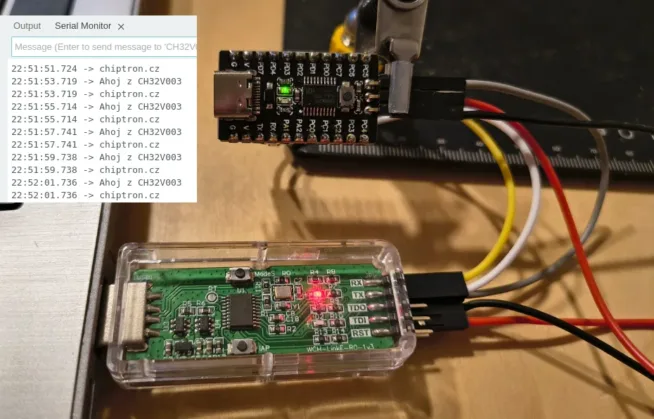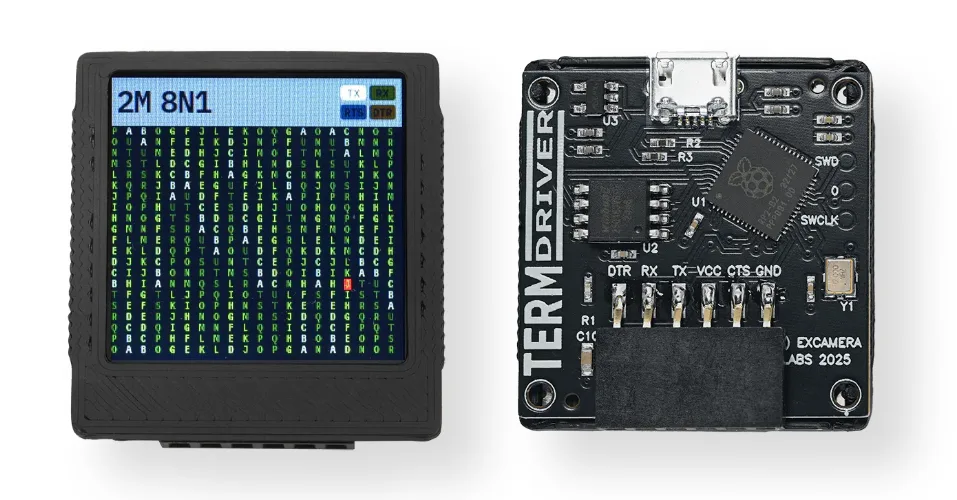
Lab401 presents its TermDriver 2, a device that simplifies debugging and communication between devices without the need for a connected computer. On the built-in LCD display, you can see real-time communication directly – no external monitor, computer, or software required. Additionally, you can expand TermDriver 2 with I2C and SPI bus decoding.
Description and Technical Specifications
- Architecture: runs on a dual-core RP2040 (ARM Cortex-M0+)
- Baud Rate: supports baud rates from 110 bps to 2 Mbps, automatically detects baud rate and configuration (parity, stop bits)
- Input Buffer Memory: 32 kB hardware buffer for receiving data.
- Power and Output: output voltage up to 3.3 V with a current of approximately 350 mA. Yes, TermDriver 2 can limitedly power other devices.
- Display: Built-in high-resolution IPS display (230 ppi).
- Control Signals: real-time monitoring of RTS, DTR states.
- Operation: thanks to the dual-core RP2040, one core can handle USB-UART communication while the other core takes care of screen rendering via SPI + DMA.
- OS Compatibility: works without the need for special drivers on Windows, macOS, and Linux — thanks to the FTDI chip that supports CDC ACM.
- Firmware & Hardware: open-source (BSD 3 license), meaning you can modify and customize it.
Possible Uses
Haven’t found a use for it while reading this article? How about these?
- Debugging Embedded Systems: during microcontroller development, booting, or failures – TermDriver 2 allows you to see what is being sent and received directly on the display.
- Monitoring Headless Devices: ideal for Raspberry Pi, Linux SBCs, routers, or other “headless” systems that run without a monitor.
- Field Work: thanks to the standalone display, you can take the device to the field, laboratory, or customer – without a laptop.
- Remote Logging: if you use an SD card / external logging (if the firmware allows), you can save serial line outputs – useful for diagnosing errors.
Expansion for I2C and SPI
UART is great, but how about I2C or SPI buses? Lab401 has thought of that too and offers expansions specifically for these communication protocols.
I²CDriver (35.09 EUR link)
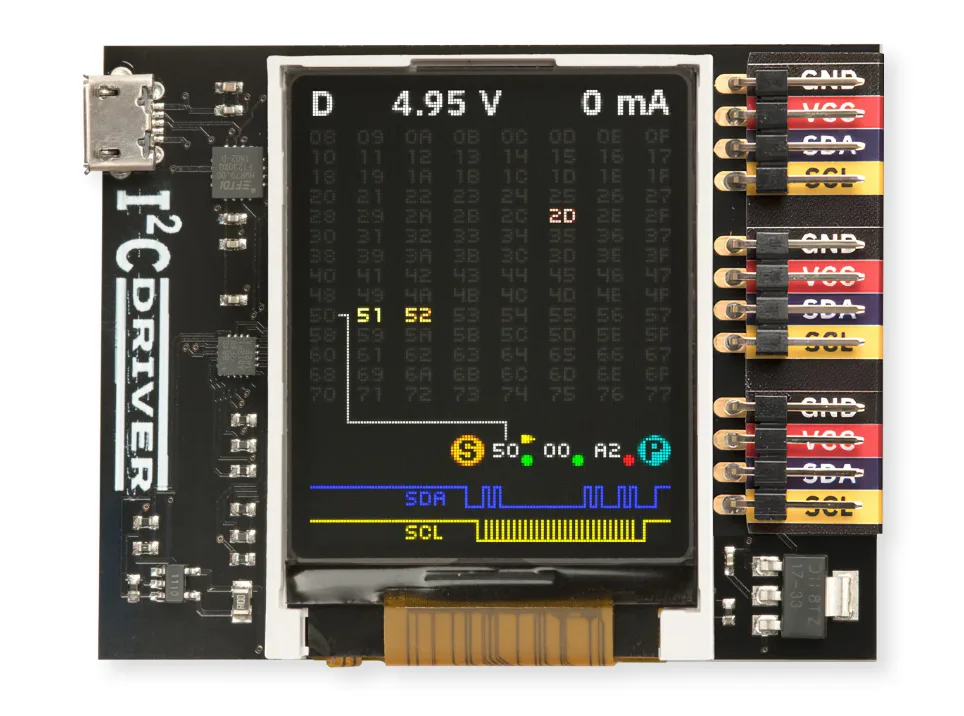
- Purpose: USB-I²C adapter with a logic analyzer featuring three I²C channels.
- Functions:
- Modes: Master, Passive, and Capture up to 400 kHz.
- Integrated 230 ppi IPS display showing I²C traffic graphs and a “temperature” utilization map of nodes (heatmap).
- Three separate I²C outputs (triple-header), supporting both 3.3 V and 5 V logic, with up to 470 mA output current.
- Power supply and measurement of target device current consumption, real-time monitoring of voltage, temperature, and uptime.
- Support for all basic I²C functions: 7-/10-bit addressing, clock stretch, arbitration.
- Software: CLI interface, GUI, support for Python 2/3 and C/C++ libraries, open-source firmware and hardware.
- Usage: Detection of I²C devices, debugging sensor registers, testing the bus, reverse engineering.
SPIDriver (35.09 EUR link)
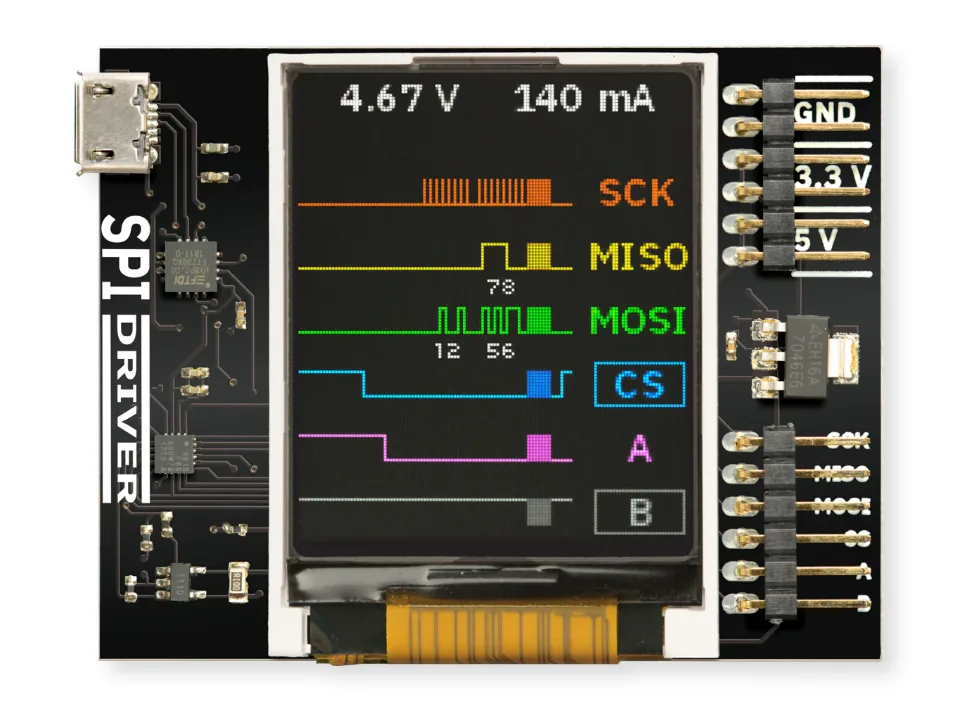
- Purpose: USB-SPI adapter for debugging, flashing, and testing SPI devices.
- Functions:
- Logic analyzer for real-time SPI operation and registers. Speed up to 500 kbps.
- Ability to backup, clone, and program SPI devices, including microcontrollers or Flash memory.
- Output power of 3.3 V and 5 V up to 470 mA via dual pins – you can power external SPI devices directly.
- Real-time monitoring of voltage, current, temperature, and uptime.
- Display: IPS 230 ppi, shows SPI data, registers, and consumption.
- OS Compatibility: driver-free (Windows, macOS, Linux), thanks to the FTDI controller.
- Software: CLI, GUI, Python 2/3, C/C++, open-source firmware and hardware.
- Usage: Development and testing of SPI Flash memories, microcontrollers, sensors; debugging SPI-based peripherals; cloning firmware, etc.
TermDriver 2 from Lab401 is not just an ordinary USB-UART converter. It is a standalone terminal display, a debugging tool, and significantly simplifies working with embedded systems where you want a visual overview of serial communication without a computer. And if you need to debug I²C or SPI devices, I²CDriver and SPIDriver from the same manufacturer make the perfect expansion.
TermDriver 2 for 30.25 EUR https://lab401.com/products/termdriver2
User Guide https://termdriver.com/termdriver2.pdf