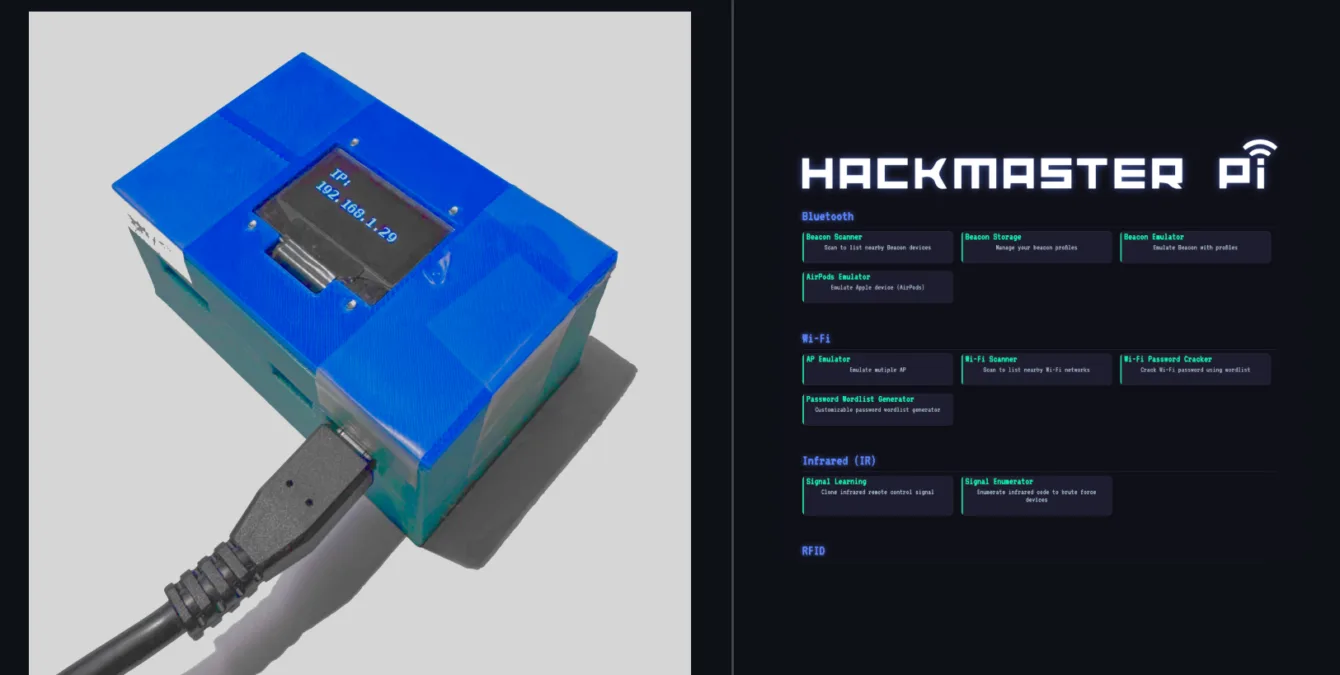
The HackMaster Pi project is a cheap, open, and modular tool built on Raspberry Pi that allows simulating and analyzing various attacks.
HackMaster Pi is an open-source project primarily designed for education and experimentation in the field of security. The goal is not to “hack for the sake of hacking,” but to understand how systems work – and where their weaknesses lie.
What is it?
It is a multifunctional IoT security toolkit that combines several technologies into one device.
The device can (or will be able to):
- analyze and test Wi-Fi communication
- work with Bluetooth devices (e.g., emulating AirPods and Beacons or scanning)
- identify and clone NFC / RFID
- control devices via infrared interface (planned)
- function as a USB attack tool (device emulation) (planned)
All of this runs on one small device that costs around 30 dollars.
This project can be compared to existing projects like Flipper Zero or Chameleon Ultra. Of course, HackMaster Pi is not at the same level as the aforementioned projects, but it is another interesting and usable project that could entertain people both in and out of the field.
Hardware
The project is built on the platform:
- Raspberry Pi Zero 2 W
- and among the modules are:
- NFC (e.g., PN532)
- IR transmitter/receiver
- OLED display
- additional expansion modules
The HackMaster Pi project is a living project, and the software is updated and gradually improved on GitHub.
Interestingly, there is a web UI where you can simply click on the desired function right in your browser.
Even though the project is still in development and does not have as many features compared to “competitors,” it has its strengths, such as a very low hardware cost and the ability to understand the problem in detail (open-source).
GitHub page of the project https://github.com/1PingSun/HackMaster-Pi?tab=readme-ov-file
Project page (how to get started) https://hackmasterpi.org/initial-settings/install-os/