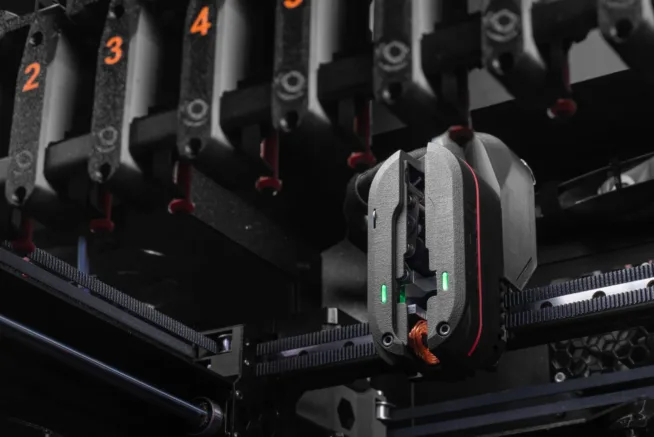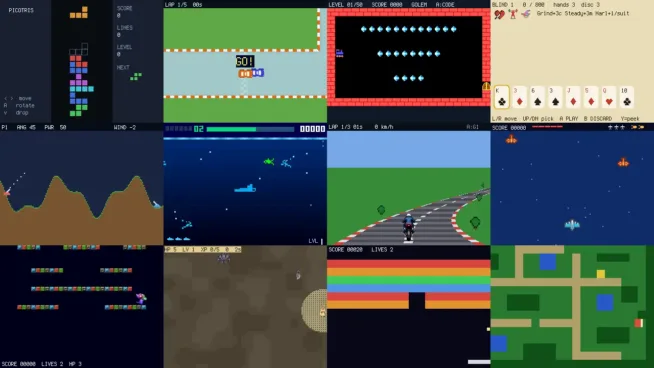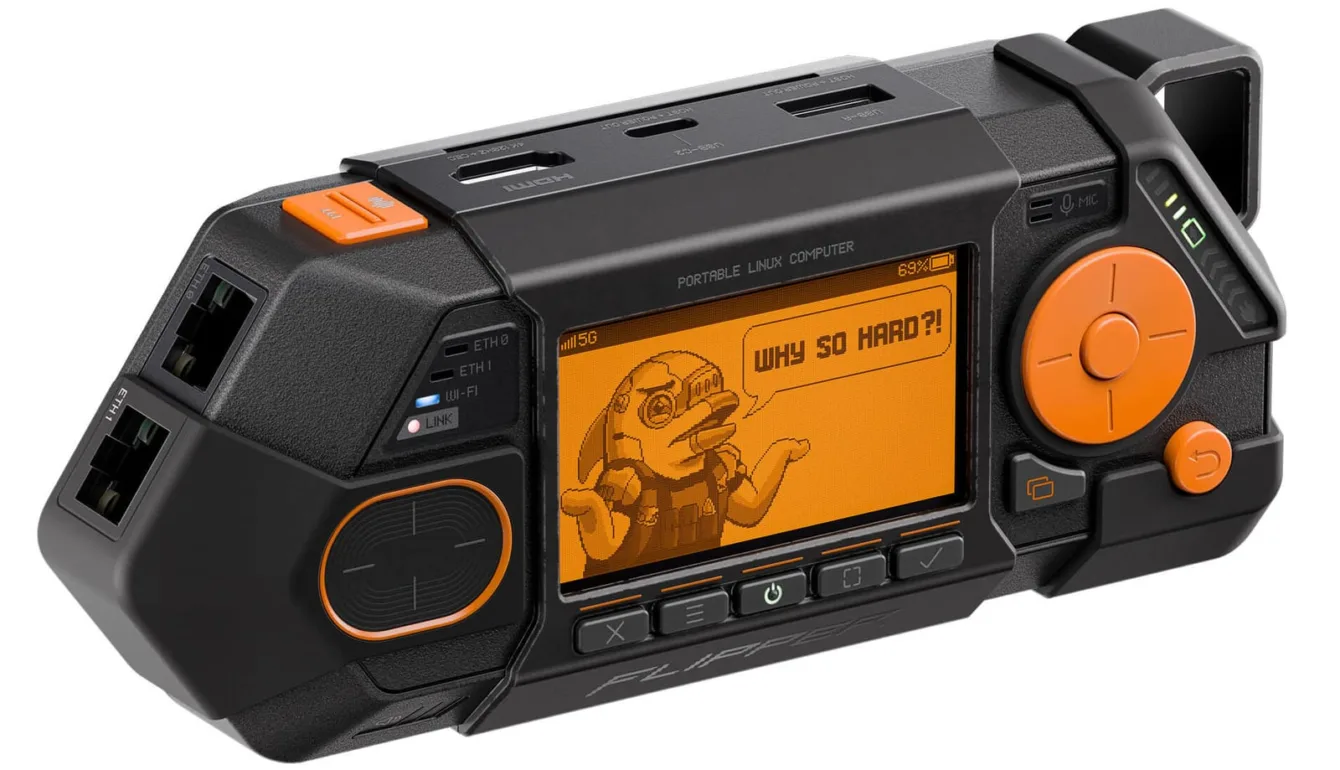
The Flipper Devices team officially unveiled their new project Flipper One today. It’s not a successor to the popular Flipper Zero, but a completely different device with its own focus. While Zero is a pocket multitool for wireless protocols and access systems, Flipper One is a full Linux machine in cyberdeck form, built for network analysis, pentesting, and serious IP-network work.
The most interesting part: the team isn’t shipping a finished product. They openly admit the project is huge, both technically and financially, and they’re asking the community for help with development.
What exactly is Flipper?
For anyone who hasn’t met Flipper yet: it’s an open-source hacking tool from Flipper Devices. The first and still best-known product is Flipper Zero, a credit-card-sized handheld that works with a bunch of wireless technologies. The pixel-art dolphin interface helped it build a massive community—roughly a million units are out there, according to the company.
Flipper Zero can read, clone, and emulate RFID cards, NFC tags, infrared remotes, sub-GHz radio signals (garage doors, doorbells, etc.), and iButton keys. It also works as a BadUSB device, and you can add Wi-Fi, extra sensors, or your own hardware through the GPIO. Everything runs on an STM32WB55 with FreeRTOS and is completely standalone—no computer or phone required.
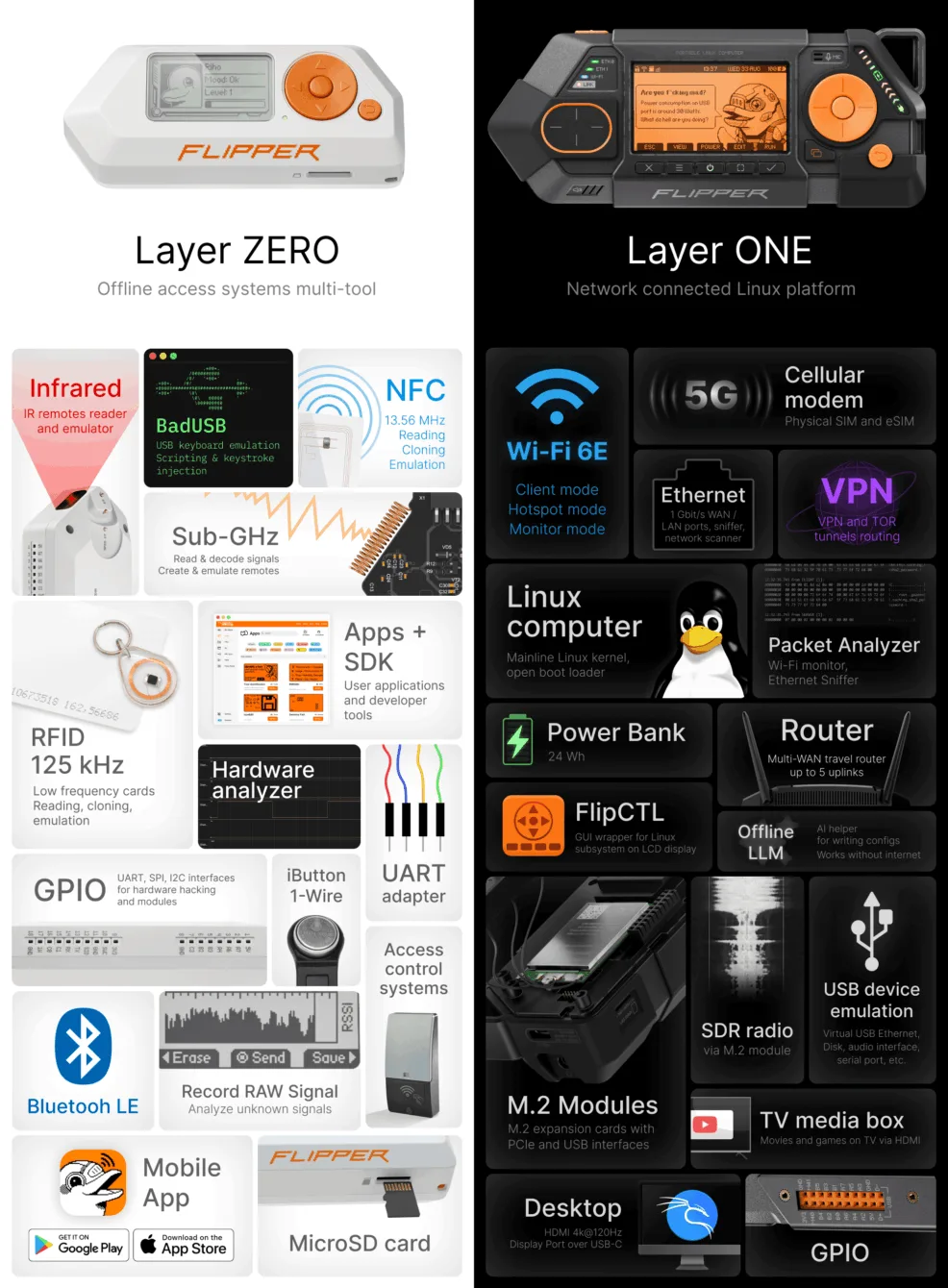
Flipper One – what it is and what it can do
Flipper One is an open Linux platform you can turn into almost anything—from a 5G IP-network analyzer to an SDR receiver running local AI. At its heart is an eight-core Rockchip RK3576 with a Mali-G52 GPU, NPU accelerator, and 8 GB RAM. Next to the main CPU sits a Raspberry Pi RP2350 coprocessor handling the display, buttons, touchpad, LEDs, and power management.
This dual-processor setup is one of the key differences from ordinary single-board computers. Thanks to the MCU coprocessor, you can still navigate menus, change settings, and boot the device even when the main Linux system is powered off.
Connectivity and networking
Flipper One is first and foremost a network multitool. It includes:
- 2× Gigabit Ethernet – two independent ports for transparent bridge, MitM analysis, or classic WAN/LAN setups
- Wi-Fi 6E – MediaTek MT7921AUN chipset covering 2.4 / 5 / 6 GHz with monitor mode and packet injection
- USB Ethernet – network interface emulation over USB-C up to 5 Gbps
- Cellular modem – 5G/LTE support via M.2 slot with both physical nano-SIM and eSIM
- HDMI 2.1 – full-size connector (not mini/micro) with 4K@120 Hz and CEC support
- 2× USB-C, USB-A, 24-pin GPIO
The device can act as a router, VPN gateway, Wi-Fi hotspot, Ethernet sniffer, or USB network adapter for a laptop or phone—any combination with dynamic routing and failover.
Expansion via M.2 and GPIO
Expandability is a core feature. Inside you’ll find an M.2 Key-B slot supporting PCIe 2.1 ×1, USB 3.1, SATA3, UART, and I2C. You can drop in an NVMe/SATA SSD, cellular modem, SDR module, or AI accelerator. Supported sizes are 2242, 3042, and 3052.
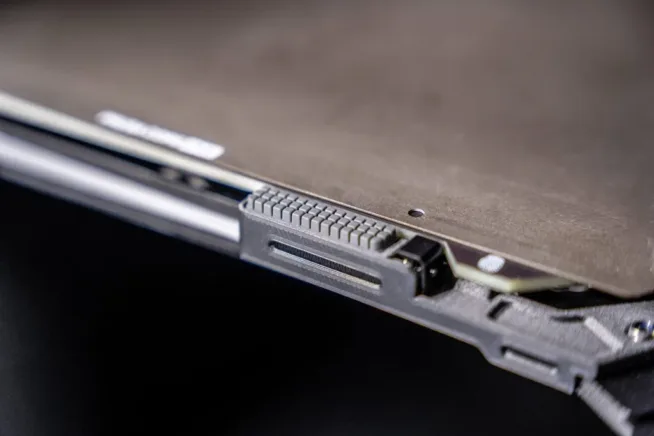
For simpler DIY additions there’s a standard 2.54 mm GPIO header. The rear cover has threaded inserts on the same pitch, so you can screw on a piece of perfboard with your own module. The mechanical design also includes snap-on covers to protect the module when you’re carrying it.
Full 3D models of the case are public, so the community can design custom rear covers, antenna rails, and modules.
Flipper OS and FlipCTL
On the software side, Flipper One starts with Debian but adds its own layer called Flipper OS. It introduces the concept of profiles—complete system snapshots with different packages and configs. You can have a routing profile, an SDR analysis profile, a media-center profile, and switch between them without reflashing the SD card.
There’s also the FlipCTL framework for building menu-based interfaces on small screens. It wraps classic Linux tools (ping, nmap, traceroute) in a clean UI controlled by the D-pad. The long-term goal is to make FlipCTL installable on any embedded Linux box with apt install flipctl.
Local AI and satellite connectivity
Thanks to the built-in NPU, Flipper One can run language models locally with no internet. The team plans to train a specialized model that knows the device inside out and can help with configuration even when offline.
Another ambitious plan is support for satellite NTN (Non-Terrestrial Networks) connectivity—the 3GPP-standardized part of 5G that phones already use for emergency SOS messages in areas without coverage. With the right M.2 module, Flipper One could talk directly to satellites.
Flipper Zero vs. Flipper One – comparison
| Feature | Flipper Zero | Flipper One |
|---|---|---|
| Focus | Offline wireless protocols (RFID, NFC, Sub-GHz, IR) | IP networks, network analysis, Linux computing |
| Processor | STM32WB55 (Cortex-M4, 64 MHz) | Rockchip RK3576 (8 cores) + RP2350 coprocessor |
| RAM | 256 KB SRAM | 8 GB |
| Operating system | FreeRTOS | Linux (Debian) + Flipper OS |
| Display | 1.4″ monochrome LCD, 128×64 px | 2.39″ color LCD, 256×144 px |
| Wi-Fi | Optional via external module | Integrated Wi-Fi 6E (2.4/5/6 GHz), monitor mode |
| Ethernet | No | 2× Gigabit Ethernet |
| NFC / RFID / Sub-GHz / IR | Yes – all integrated | No – not included |
| HDMI output | No | HDMI 2.1 (4K@120 Hz) |
| Expansion | GPIO pins, external modules | M.2 slot (PCIe/USB 3/SATA) + GPIO |
| Cellular data | No | 5G/LTE via M.2 modem |
| AI / NPU | No | Yes – NPU for local LLMs |
| Battery | 2 000 mAh (up to 28 days standby) | 24 Wh (runtime not yet specified) |
| Price | $199 | Not announced yet |
The key point is that Flipper One does not replace Flipper Zero. The team compares them to network layers: Zero works at layer 0—offline point-to-point protocols like NFC, RFID, Sub-GHz, and IR. One operates at layer 1 and above—everything connected to an IP network: Wi-Fi, Ethernet, 5G, satellite. They’re complementary tools, not successive generations of the same product.
Open development and the call for community help
Flipper One takes an unusually open approach to development. The team published a Developer Portal with full documentation, task trackers, internal discussions, and unfinished designs. The project is split into several sub-projects—hardware, mechanics, Linux software, MCU firmware, UI/UX, documentation, and testing—and anyone can jump in.
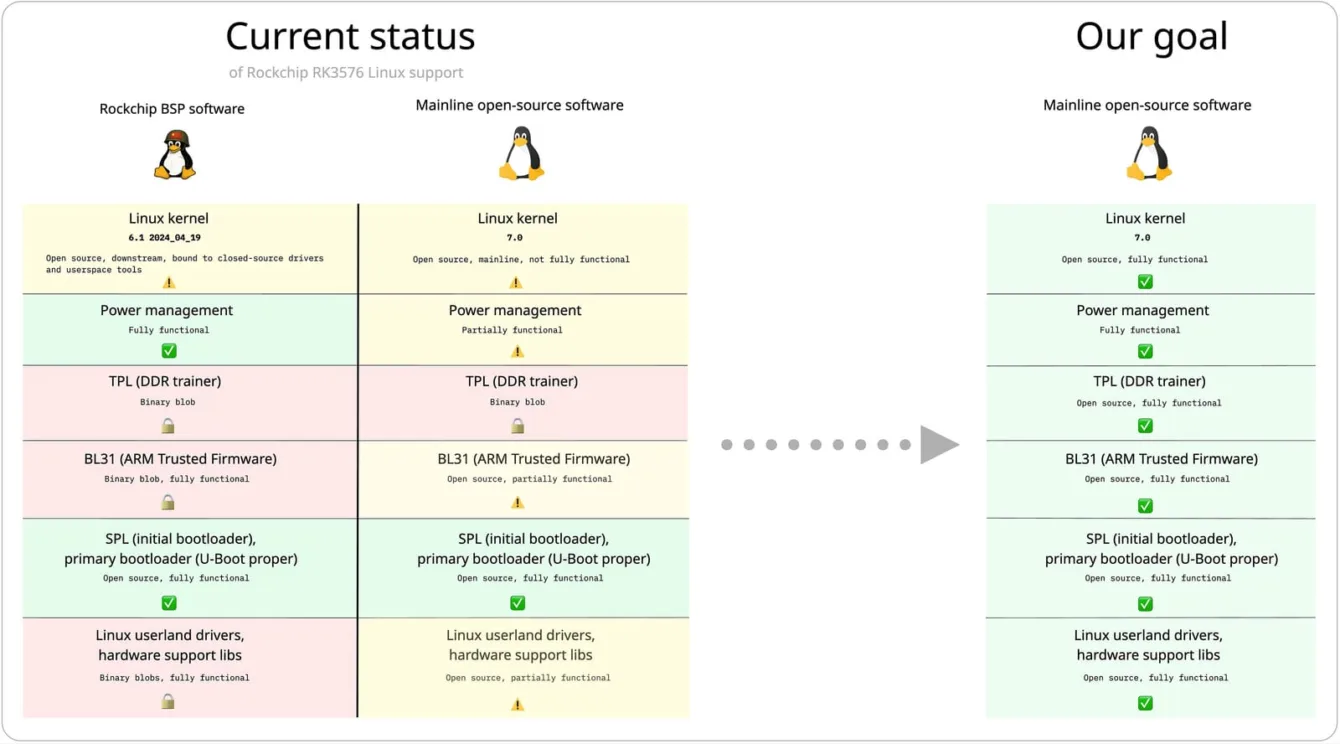
They’re especially looking for help with:
- Mainline Linux support for the RK3576 (in cooperation with Collabora)
- Removing the last binary blob in the boot chain (DDR trainer)
- Testing the MT7921AUN Wi-Fi chipset
- Designing a desktop environment for small screens
- Shaping the Flipper OS and profile system
The goal is to create the best-documented ARM computer in the world with full mainline Linux kernel support—no vendor patches, proprietary drivers, or closed BSP packages.
My take
Flipper One is an extremely ambitious project that tries to push what a pocket Linux device can actually do. The combination of a powerful ARM processor, dual-CPU architecture, rich connectivity, and real emphasis on openness makes sense—but the road to a finished product will be long. No release date or price has been announced yet.
If the project caught your interest, you can follow the development on the Flipper One Developer Portal or on X.com/Flipper_RND.