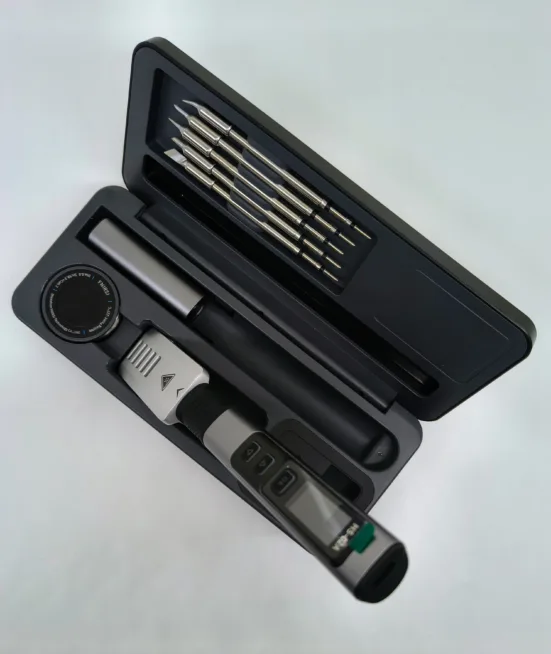
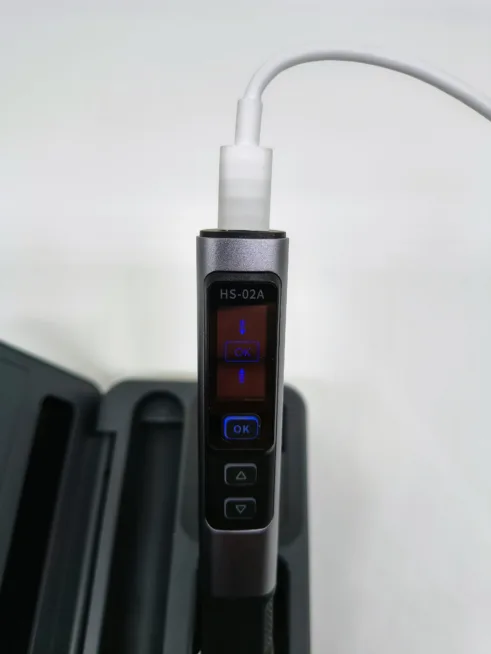
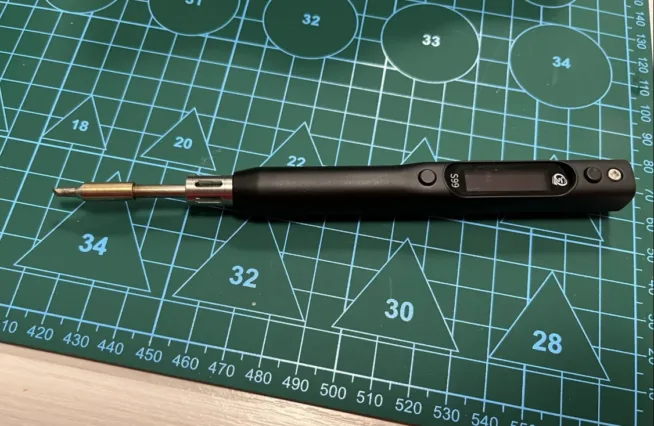
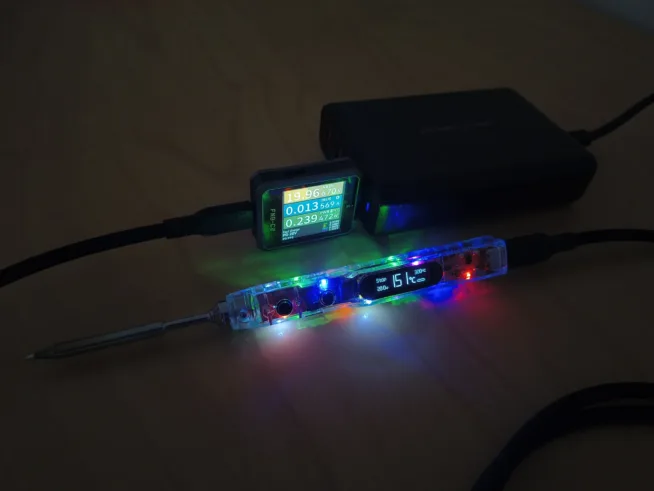
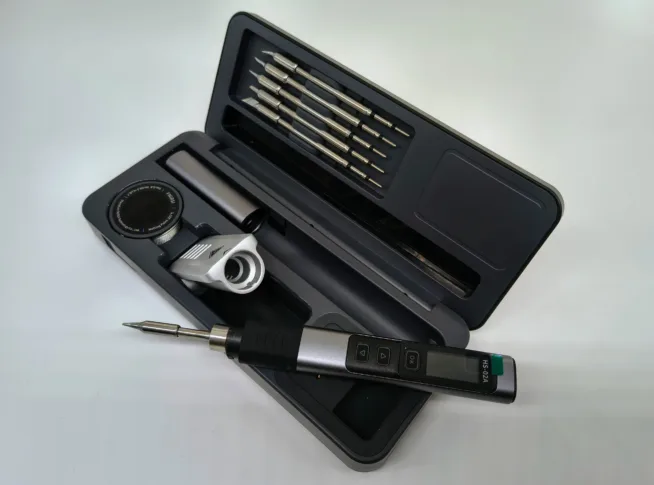
I got my hands on the soldering pen from FNIRSI, model HS-02A. I spent a few hours soldering with the pen, and I can share my impressions. The soldering pen is stored in a very elegant box that contains everything you need for the soldering process.
Thanks for lending the soldering pen go to Martin Kiklhorn (Twitter/X).
The FNIRSI brand is not unknown – its products are very popular and sought after. With its pricing, it offers high-quality products such as USB testers, portable oscilloscopes, component testers, and multimeters. And I’ve only listed a few things that FNIRSI manufactures.
Five years ago, I bought a USB-C adjustable power supply and I was extremely satisfied with it. What about this soldering pen?
FNIRSI HS-02A
This model is sold in several variants, as is often the case – just the case, case and soldering pen, with additional tips, or even a power adapter. The price varies accordingly – from around 26 EUR for just the box to 90 EUR for the complete set. I received the version without a power supply, which at the time of writing this article is around 64 EUR (on fnirsi or aliexpress) excluding VAT and shipping.
The soldering pen can be powered via USB-C, supporting both USB PD and USB QC. The minimum voltage is 9V and the maximum can go up to 20V. The soldering pen can also be powered from a battery pack using an adapter from a coaxial connector to USB-C.
The power that the soldering pen can utilize is up to 100W, and the data is displayed on a 0.96″ IPS display. The temperature range is from 100°C to 450°C.
The soldering iron offers the option to have three preset temperature profiles and also temperature step settings. Of course, there is also a standby mode setting – sleep mode (time and temperature) as well as a shutdown time when idle.
The soldering pen also has a buzzer, which can fortunately be turned off. The power can be adjusted – or limited if needed, in percentages.
The soldering iron has an antistatic screw for grounding the soldering tool.
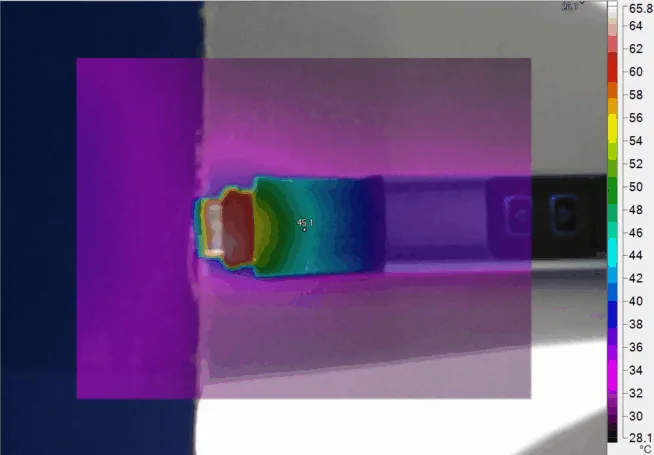
The pen features a silicone handle. Even with the silicone handle, after extended use, the pen heats up to a point where holding it becomes quite uncomfortable.
The pen itself weighs 51.5g without the cable and soldering tip and has a diameter of two centimeters. The weight is slightly higher than that of the more complex soldering tweezers SEQURE HT140 and much heavier than the competing Pinecil v2 (30g with soldering tip).
I would add a silicone USB-C cable to the soldering pen – I hope that the most expensive variant of the set (with the adapter) includes such a cable.
Despite using (my) 100W adapter and 100W USB-C cables (I tried several adapters and cables), the soldering pen reset itself.
This might be the reason why the factory setting limits the power to 65%.
The solution is to limit the power or perhaps a firmware modification, which must be done by the manufacturer. I have the latest version 1.8, and this protection is not included.
Upgrading the firmware is not complicated – connect the soldering pen to a USB port on your computer, press OK for a long time, and navigate to the Firmware update in the menu. The soldering pen then behaves like a “classic flash drive” (mass storage), and you simply copy the BIN file into the folder.
And when the soldering pen does not reset (the soldering pen can take up to 100W of power (20V / 5A), and I set the power to 80%), the heating of the soldering pen is slower than I am used to with other soldering tools. For example, in comparison with the SEQURE HT140 soldering tweezers.
The HS-02A soldering pen heats up from 30°C to 330°C with the power limited to 80% (due to the reset of the soldering tool) in about 7 seconds.
Conclusion
The box is robust and well thought out. The entire soldering pen with a wire brush cleaner for the soldering tip, solder (tin), and spare tips is compactly assembled into one box.
From my perspective, the disadvantages include the higher weight of 51.5g compared to the competing Pinecil v2, which weighs only 30g. I would supplement the packaging with a silicone USB-C cable (the product page does not specify what material the USB-C is made of in case you purchase the most expensive variant of the set with the adapter).
The soldering pen does not have under-voltage protection. Although I used (my) 100W adapter and tested 100W USB-C cables, the soldering pen still occasionally reset itself. A solution would be a firmware modification that would monitor the minimum measured voltage and adjust the current power accordingly. Or you can limit the maximum power; the default is 65%.
And my last complaint would be about the slower heating, going from 30° to 330°C (80% power) in 7 seconds is not impressive.
The overall impression is mixed – the box is very well made, but that does not affect everyday soldering. The resetting issue can be resolved with a firmware modification – if the manufacturer wants to.
Unfortunately, what affects working with the soldering pen is the higher weight and heating through the silicone sleeve.
Product page: https://www.fnirsi.com/products/hs-02-toolbox