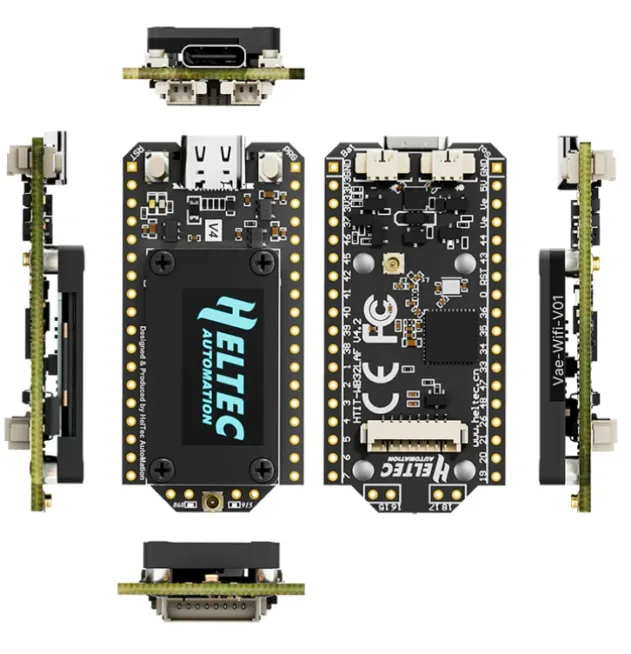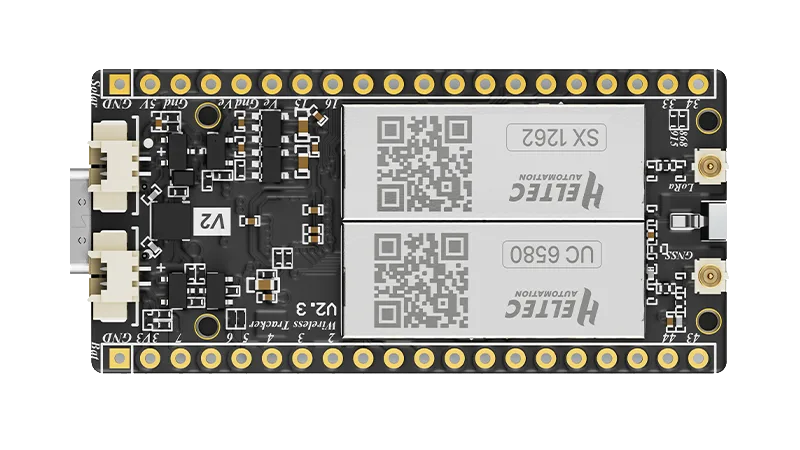
Heltec Automation has come up with a new generation of the popular tracker. The Wireless Tracker V2 builds on the proven foundation of the first version, ESP32-S3, LoRa, and GNSS module, but brings several significant improvements – stronger transmitter, smaller dimensions, and support for a solar panel.
What is Wireless Tracker V2?
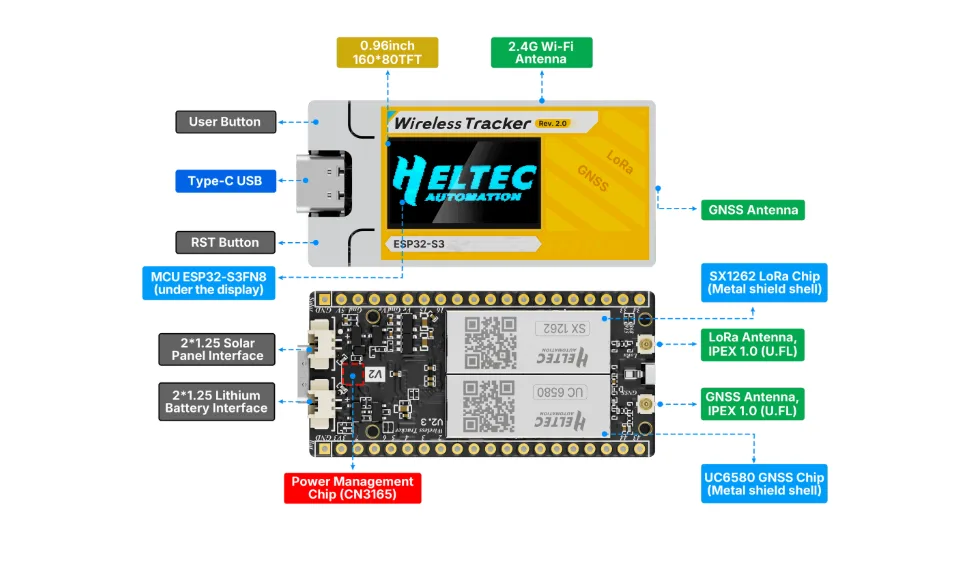
The Wireless Tracker V2 is built on the ESP32-S3FN8 microcontroller and integrates the LoRa chip SX1262 along with the GNSS chip UC6580 – the same as in V1.
It is a compact development board that combines Wi-Fi, Bluetooth, LoRa, and satellite navigation in one module – making it highly sought after by people involved in Meshtastic and MeshCore networks.
Improvements over V1
The biggest leap compared to its predecessor is the transmitter power. The new generation integrates a power amplifier (PA), allowing it to achieve a maximum transmission power of up to 28 ±1 dBm, while the LNA (Low Noise Amplifier) can be bridged without negatively impacting reception performance.
V1 had a maximum transmission power of “only” 21 ±1 dBm.
This means significantly longer range for LoRa communication compared to standard modules.
Another significant improvement is the support for charging via a solar panel.
Technical Specifications
The processor is still the dual-core ESP32-S3FN8 (Xtensa 32-bit LX7), with the LoRa functionality provided by the SX1262 chip, which has a receiver sensitivity of up to -134 dBm. The GNSS chip UC6580 supports all major satellite systems – GPS, GLONASS, BDS (BeiDou), Galileo, NAVIC, and QZSS.
The board offers Wi-Fi 802.11 b/g/n with speeds up to 150 Mbps and Bluetooth 5, including support for Bluetooth Mesh. Hardware resources include 7× ADC1, 2× ADC2, 3× UART, 2× I2C, 2× SPI, and much more.
The dimensions of the board are just 52 × 25.4 × 10.26 mm, significantly smaller compared to V1, which measured 65.48 x 28.06 x 13.52 mm.
Interfaces and Connectors
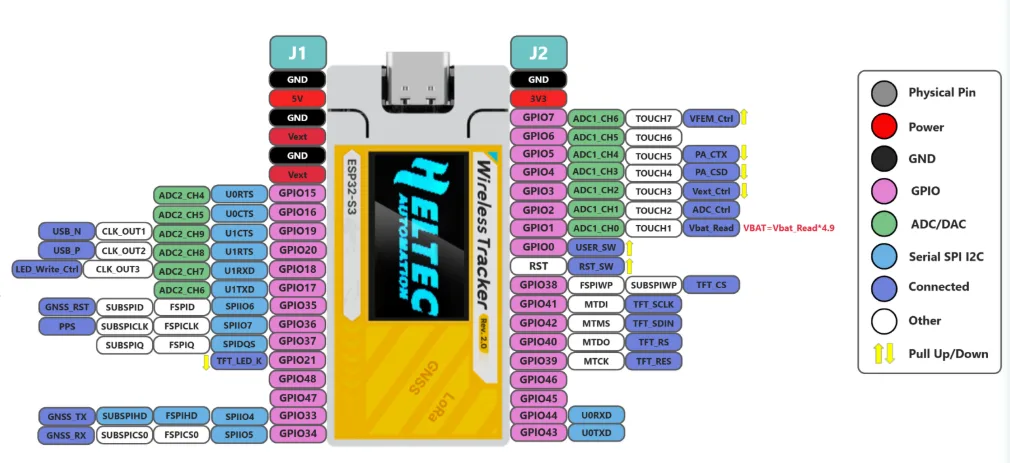
The board features a USB-C interface for programming and charging the battery. A new connector for the solar panel (1.25-2P) has been added. The same connector is also used for connecting a Li-Ion battery.
The chip used for charging the Li-Ion battery, which can be powered from the solar panel or USB-C, is the CN3165 chip.
The maximum input voltage is 6V, so I recommend using a solar panel with a maximum of 5V.
The set charging current is approximately 550 mA (Rset is 2k2). Therefore, do not connect a battery with a capacity lower than 550 mAh, meaning a charging rate of 1C, which is still a safe charging current.
MeshCore and Meshtastic
The Wireless Tracker V2 is already supported in the Meshtastic projects (web flasher) and MeshCore (web flasher).
Conclusion
The improvements in terms of higher transmission power, low-noise amplifier, smaller dimensions, and support for charging via a solar panel significantly enhance the previous version. Moreover, it is only $4 more expensive (V1 is priced at $22.90).
The Wireless Tracker is, of course, available in two variants differing in frequency – 863 – 870 MHz and 902 – 928 MHz.
The price is $26.90 excluding VAT and shipping. Currently, no one in the Czech Republic is selling it.
Product page https://heltec.org/project/wireless-tracker-v2/