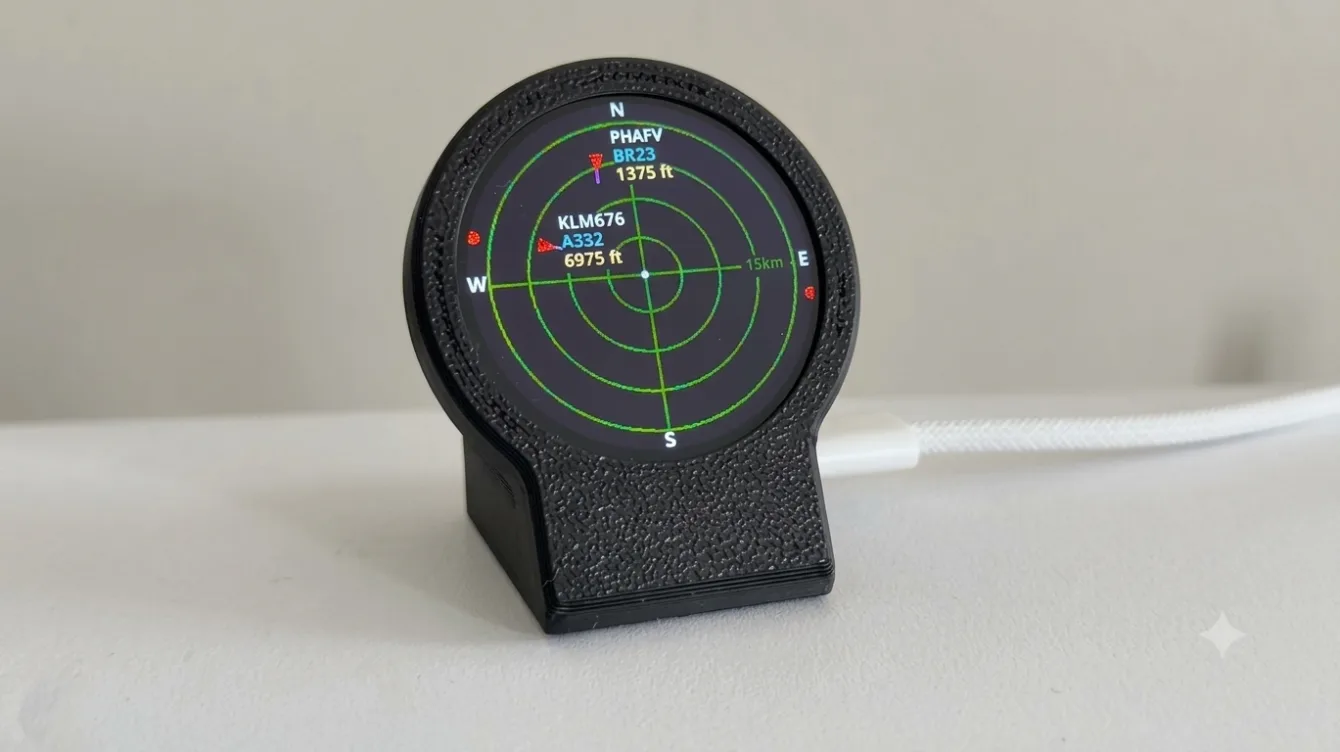
If you’ve ever wondered what plane is flying over your house, you’ve probably opened FlightRadar24 or a similar app. The ESP32 Plane Radar takes a more satisfying route: a desktop radar built on an ESP32 that shows nearby aircraft on a round display in classic PPI style.
The project was created by MatixYo, who released the full source under MIT on GitHub. It quickly gained traction in the maker community, with thousands of upvotes on Reddit and several forks appearing within weeks.
What it does
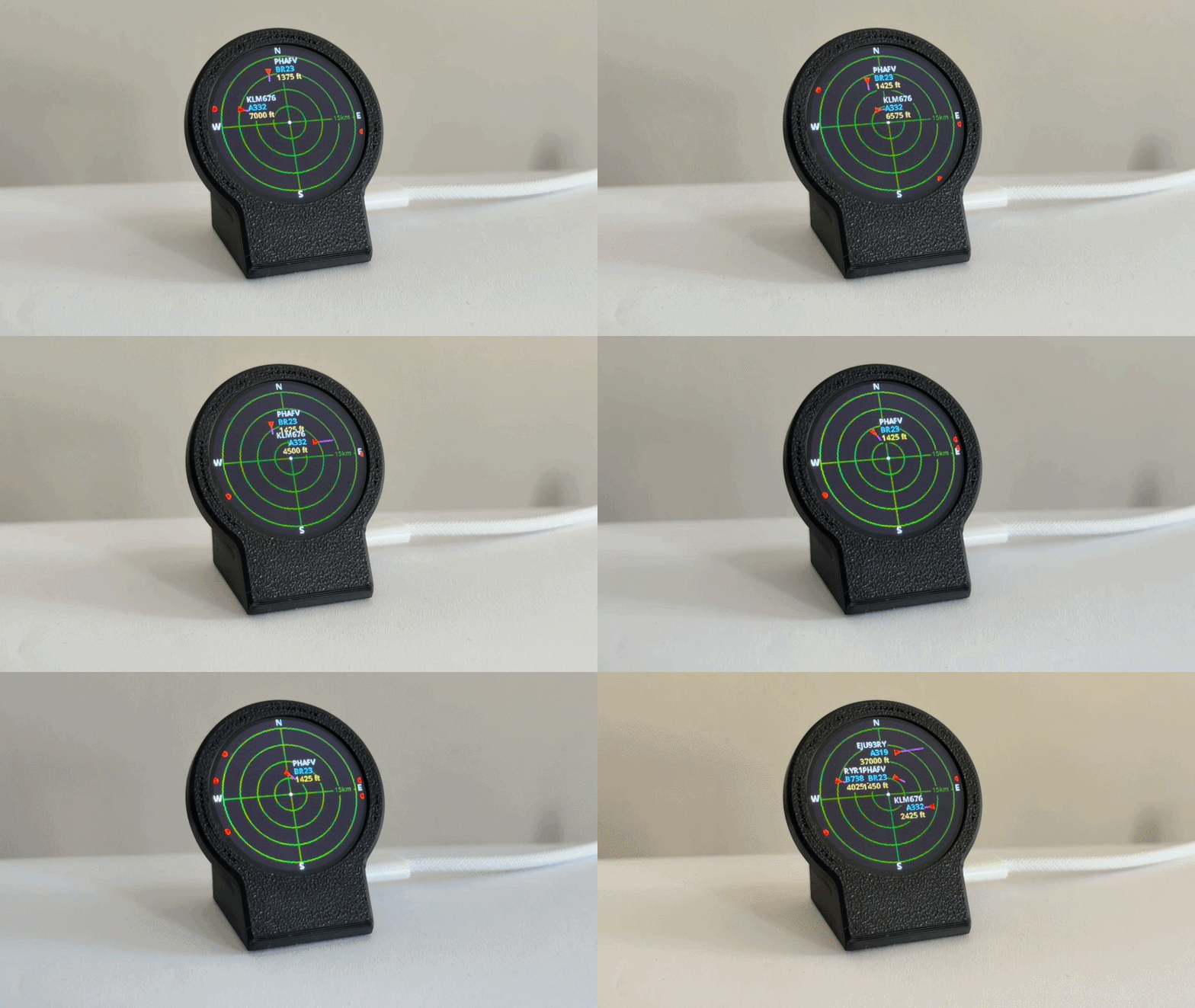
The device pulls live aircraft data from the Open Data API at adsb.fi, which aggregates ADS-B from thousands of volunteer receivers worldwide. Every five seconds the ESP32 queries the API with its configured latitude/longitude and receives a JSON list of nearby aircraft.
Each record contains position, altitude, speed, heading and callsign. The firmware calculates range and bearing relative to the user’s location and plots the targets on the circular display, complete with range rings and a crosshair.
Because the API is compatible with ADSB Exchange v2, there’s no need to run your own ADS-B receiver or decode 1090 MHz yourself.
The screen shows:
- aircraft positions relative to the chosen point,
- heading,
- altitude,
- flight ID,
- velocity vector,
- range rings and crosshair.
The result looks like a miniature radar scope straight out of a control tower.
Hardware – surprisingly minimal
The whole thing runs on an ESP32-C3 Super Mini (Czech retailer Vokolo, LaskaKit) and a 1.28″ round GC9A01 TFT (Czech retailer Vokolo, LaskaKit). Besides the MCU and display you only need:
- one button to cycle the radar range (5 → 10 → 15 → 25 km, saved to flash),
- USB power,
- optionally a 3D-printed case.
With so few parts it’s a friendly first project if you want to try ESP32, TFT graphics and simple web APIs.
Configuration without recompiling
On first boot the device creates its own Wi-Fi AP and serves a small web page. You just enter:
- your home Wi-Fi credentials,
- your latitude/longitude,
- preferred units.
No code changes or recompiles required.
Range switching
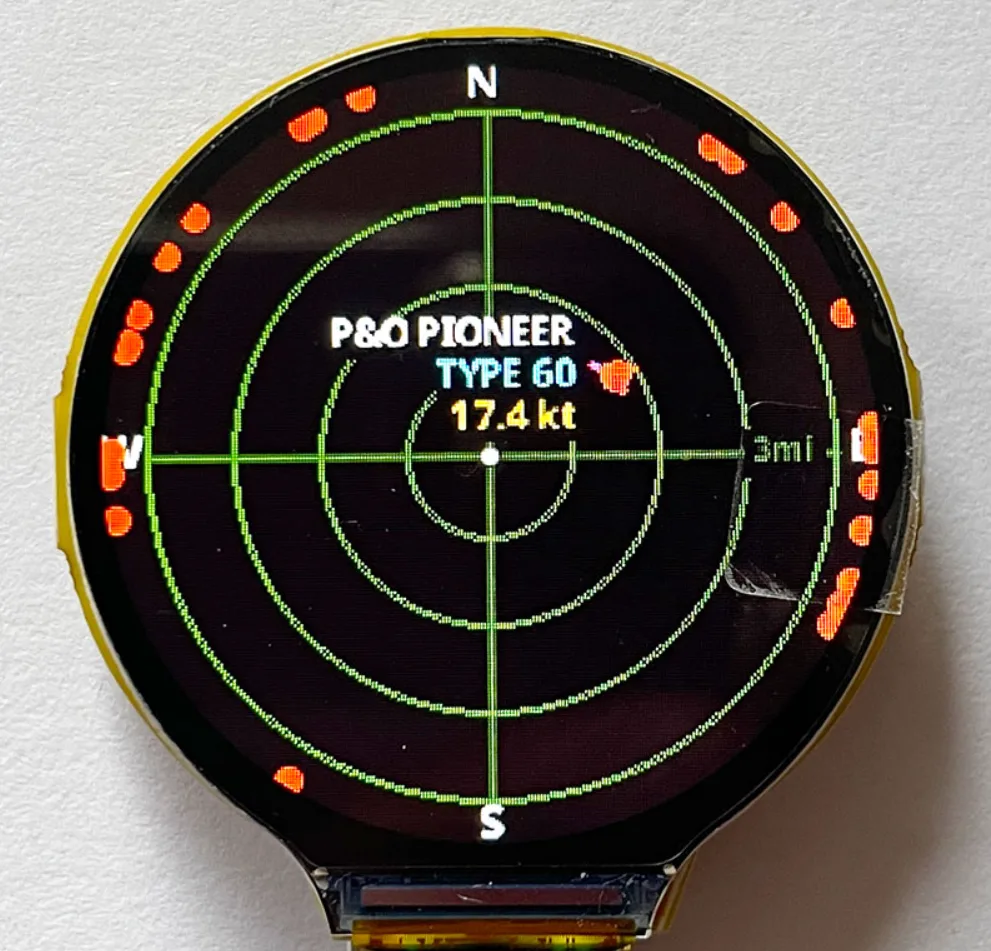
A single button cycles through the available ranges (roughly 5–25 km or miles). Aircraft outside the current scale appear as red dots on the edge of the screen, so you can watch both local airport traffic and more distant flights.
Open project, active community
The author responds quickly to suggestions; airport and runway overlays were added shortly after release. The community has already produced forks, including an AIS ship-radar version and a port to the Waveshare ESP32-S3 2.1″ 480×480 display.
My take
The ESP32 Plane Radar proves you don’t need complex or expensive hardware for a compelling IoT gadget. It combines cheap parts, public ADS-B data and clean graphics into something that earns a permanent spot on any aviation enthusiast’s desk.
Technically it’s a neat showcase of the ESP32-C3, web APIs, TFT drawing and captive-portal configuration. Most of all, it’s one of those projects that looks far more expensive and difficult than it actually is.
Project: ESP32-Plane-Radar on GitHub
Author: MatixYo GitHub profile