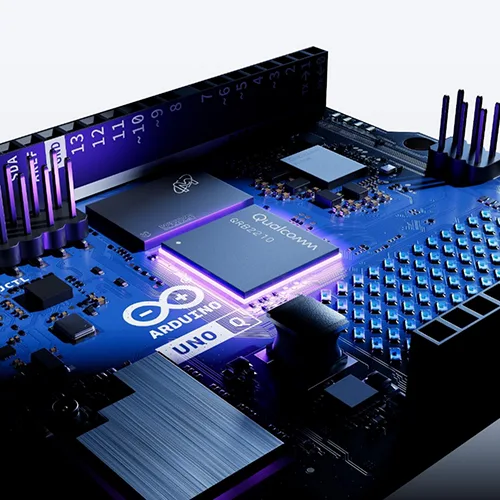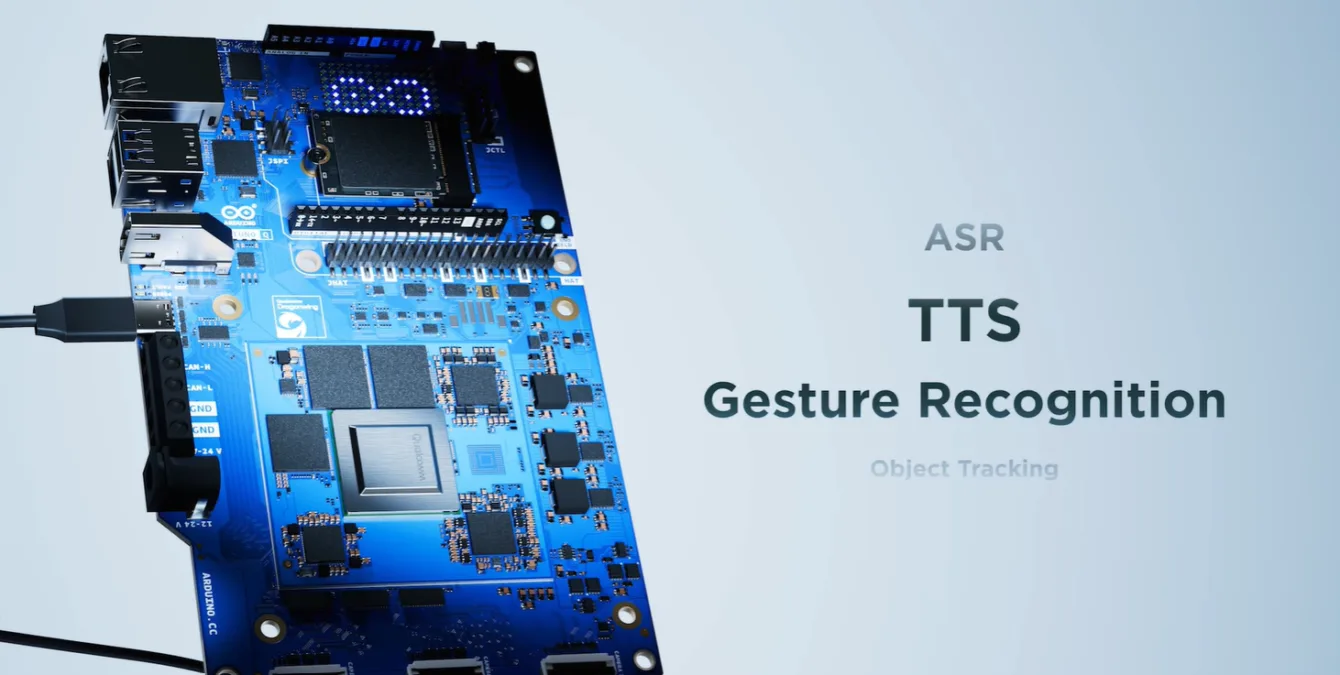
Less than half a year ago, Qualcomm entered the maker community through the acquisition of Arduino. What’s more, Qualcomm introduced its own development board – UNO Q. Now we have another addition to the family of high-performance boards – the VENTUNO Q. This one also targets AI applications.
VENTUNO Q
Even more powerful than the UNO Q, the VENTUNO Q is a board that combines the performance-packed Dragonwing™ IQ8 from Qualcomm and the STM32H5 from STMicroelectronics.
Dragonwing™ IQ8
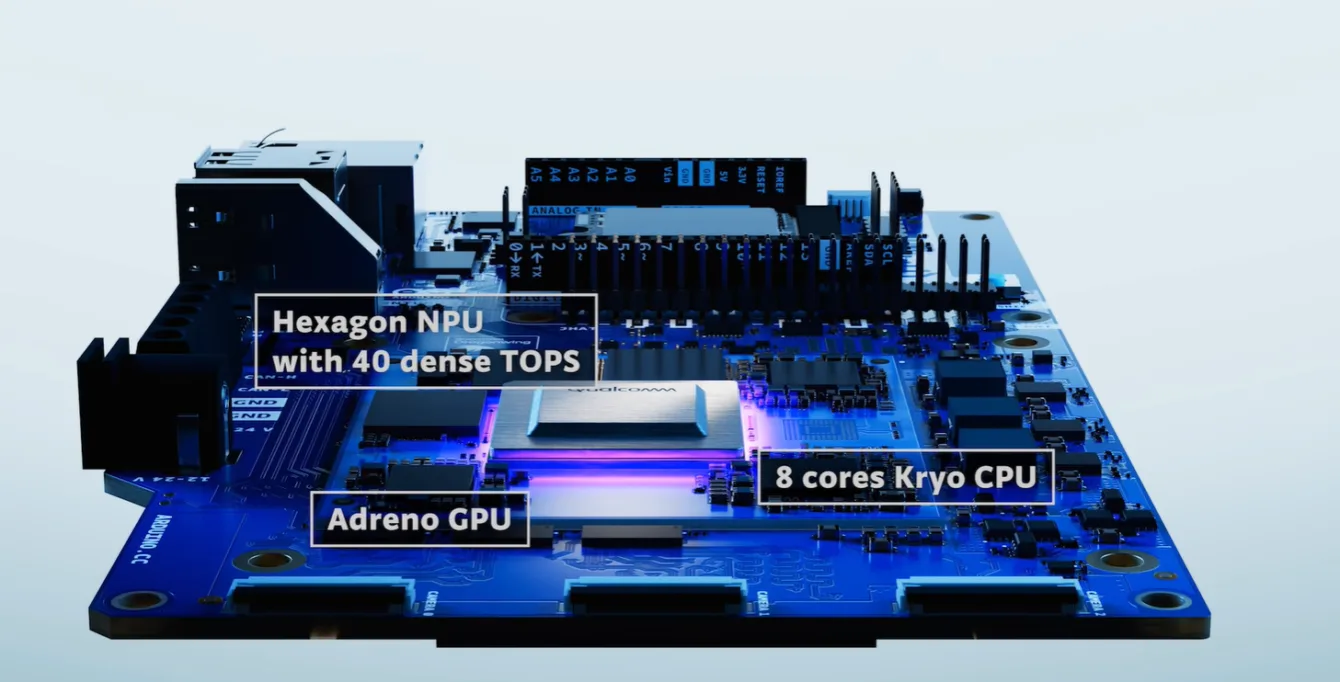
The Dragonwing IQ-8275 processor operates as an NPU, CPU, and GPU for complex neural inference.
STM32H5F5
The STM32H5F5 microcontroller here acts as the actuator for this development board. Thanks to very fast communication with the processor via RPC (Remote Procedure Call), it allows for responses in the order of milliseconds, ensuring stable, deterministic control for robotics, motion systems, and industrial interfaces.
The processor performance is 40 TOPS, the board is equipped with 16 GB RAM and also includes 64 GB eMMC memory.
The board features a module supporting Wi-Fi 6 (2.4/5/6 GHz) and Bluetooth 5.3, as well as 2.5 Gb ethernet. Of course, there is also a USB-C interface for both power and data transfer, along with an M.2 connector for NVMe storage.
You can connect up to 3 cameras to the board via the MIPI-CSI interface and use the MIPI-DSI connector or HDMI or USB-C DisplayPort for connecting a display.
Software
Programming takes place in the dedicated Arduino® App Lab environment. You can combine pre-prepared modules called Bricks with AI models and easily define the behavior of your board. App Lab supports classic C++ sketches through the Arduino IDE as well as Python, providing flexibility for development.
Link: https://www.arduino.cc/en/software/#app-lab-section
You can connect the VENTUNO Q to your computer and program it traditionally, or you can use it as a single-board computer. Just connect a monitor, keyboard, and mouse.
Usage
So what can you do with such a board?
Gesture recognition, object detection and tracking with YOLO (article on bird recognition using YOLO here), local LLM, speech understanding and transcription to text, scene description, language, images, etc.
Conclusion
Despite its strong focus on AI, the VENTUNO Q does not lose compatibility with existing Arduino Uno shields – displays, motor control, wireless connectivity.
Additionally, it includes a standard Raspberry Pi 40-pin connector for further expansion boards and also I2C connectors for SparkFun Qwiic, Adafruit STEMMA, and Laskakit uŠup.
A funny clip that appeared on the internet https://www.facebook.com/reel/1605337633860264
Product page https://www.arduino.cc/product-ventuno-q/
The price is currently unknown.
| Microprocessor (MPU) | Qualcomm Dragonwing™ IQ8 (IQ-8275): • CPU: Octa-core Arm® Cortex® • Adreno GPU/VPU: Arm® Cortex® A623 at 877 MHz • Hexagon Tensor AI Processor (NPU): up to 40 dense TOPS • Qualcomm Spectra 692 ISP OS: Ubuntu or Debian upstream |
|---|---|
| Microcontroller (MCU) | STM32H5F5: • Arm® Cortex® M33 at 250MHz • 4MB flash • 1.5MB RAM OS: Arduino core on Zephyr |
| RAM | 16GB LPDDR5 |
| Storage | • 64GB eMMC • M.2 connector for NVME Gen.4 external storage |
| Connectivity | • Wi‑Fi® 6 2.4/5/6 GHz with onboard antenna • Bluetooth® 5.3 with onboard antenna • 1x 2.5Gbit RJ45 |
| Camera | • USB camera support • 3x MIPI CSI connectors muxed with 2x MIPI CSI on JMEDIA header |
| Video | • 1x HDMI muxed with MIPI DSI on JMEDIA header • Video output (DP Alt mode) support via USB‑C • MIPI DSI pins on JMEDIA header |
| Audio | 2x Microphone IN / Headphone OUT / Ear OUT / Line OUT on JMISC header |
| Power Supply | • From USB‑C connector 5 VDC max at 3 A • 5.5×2.1 mm Power Jack 12‑24 VDC • Screw Terminal 7‑24 VDC • 7‑24 V on JOMEGA |
| USB | • 1x USB‑C port with host/device role switching, power role switch and video output • 2x USB 3.0 Type A • 2x USB 3.0 on JOMEGA header |
| CAN | • 1x CAN‑FD PHY on screw terminal • 3x CAN‑FD (no PHY) on JOMEGA header • 1x CAN‑FD (no PHY) on UNO Shield headers |
| Dimensions | 160x100x25.8 mm |