Professional seismographic stations cost tens of thousands of dollars and are run exclusively by scientific institutions. The Raspberry Shake project tears that barrier down – it offers a Raspberry Pi–based seismograph that anyone can buy and join the global network of citizen scientists tracking Earth tremors and underground blasts in real time.
What is Raspberry Shake
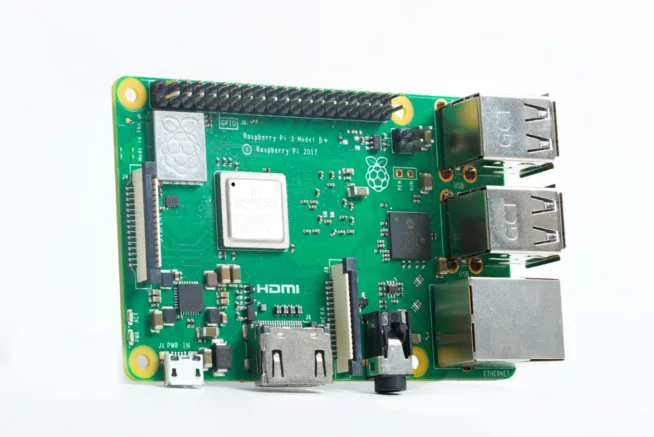
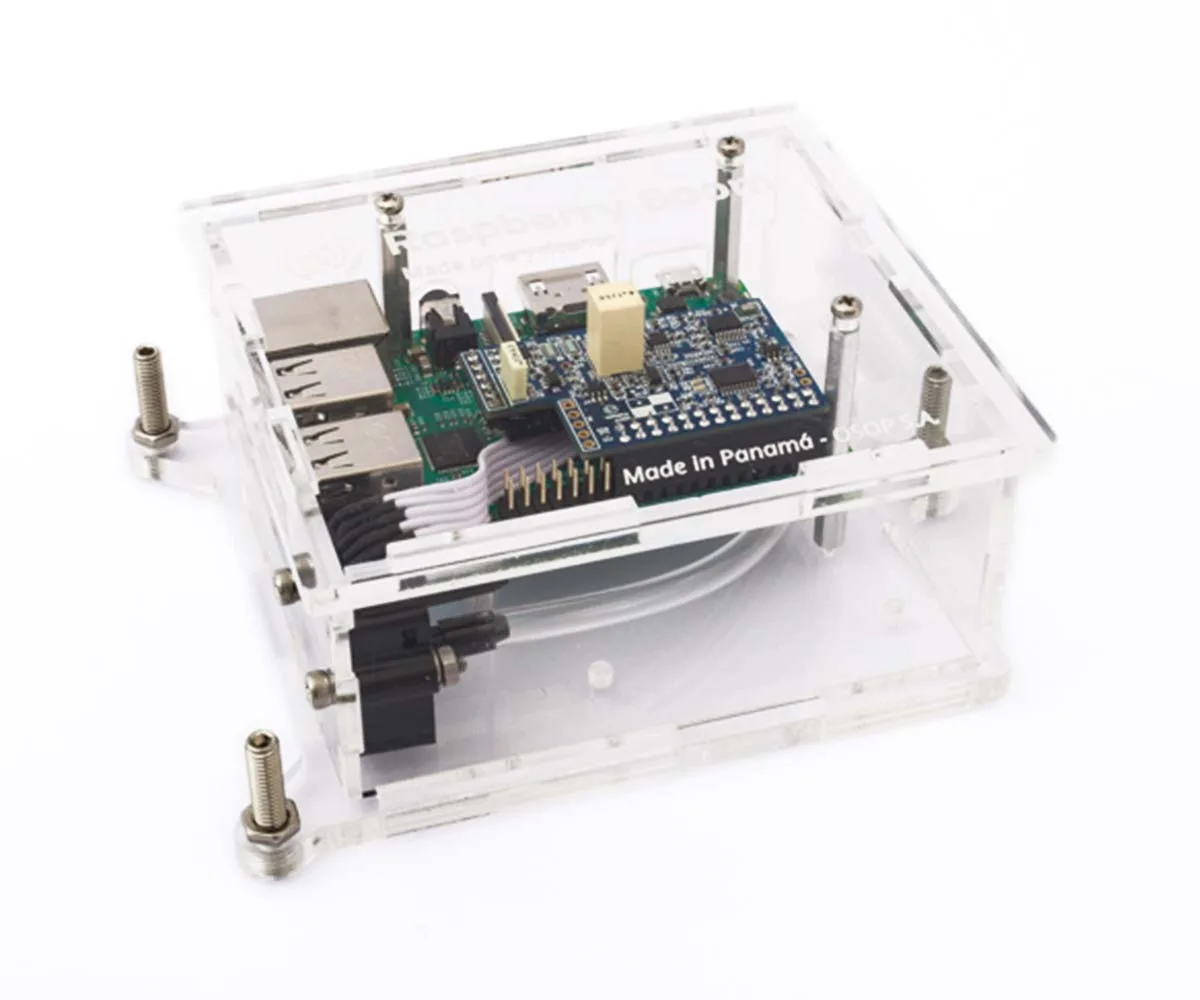
Raspberry Shake is a compact seismograph developed by the Panamanian company Raspberry Shake, S.A. It pairs professional geophones with a digitizer board and a Raspberry Pi running the custom Shake OS. The result is a fully functional seismic station that fits in the palm of your hand.
The Raspberry Shake network currently has over 2,500 active stations in more than 70 countries. Data from these stations are public and capture roughly 700 earthquakes every day. The project has been covered by Nature, Science, Wired and the New York Times – especially during the COVID-19 pandemic, when the network recorded an unprecedented global drop in seismic noise caused by human activity.
How it works
At the heart of every Raspberry Shake is a geophone – a sensor that converts ground motion into an electrical signal. It works by electromagnetic induction: a coil suspended on a spring sits above a magnet. When the ground moves, the coil moves relative to the magnet and generates a voltage proportional to the velocity of the motion.
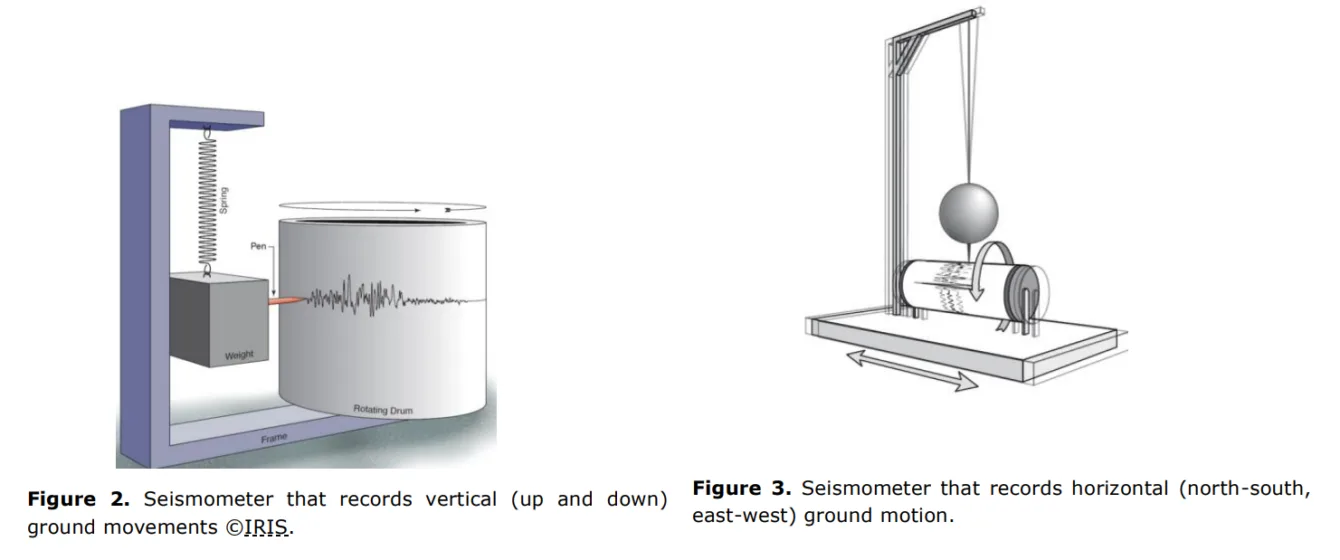
The analog signal is handled by the Shake Board, a custom digitizer that amplifies it and converts it to digital data. The Raspberry Pi running Shake OS then stores the data in miniSEED format, timestamps it and forwards it to the central server.
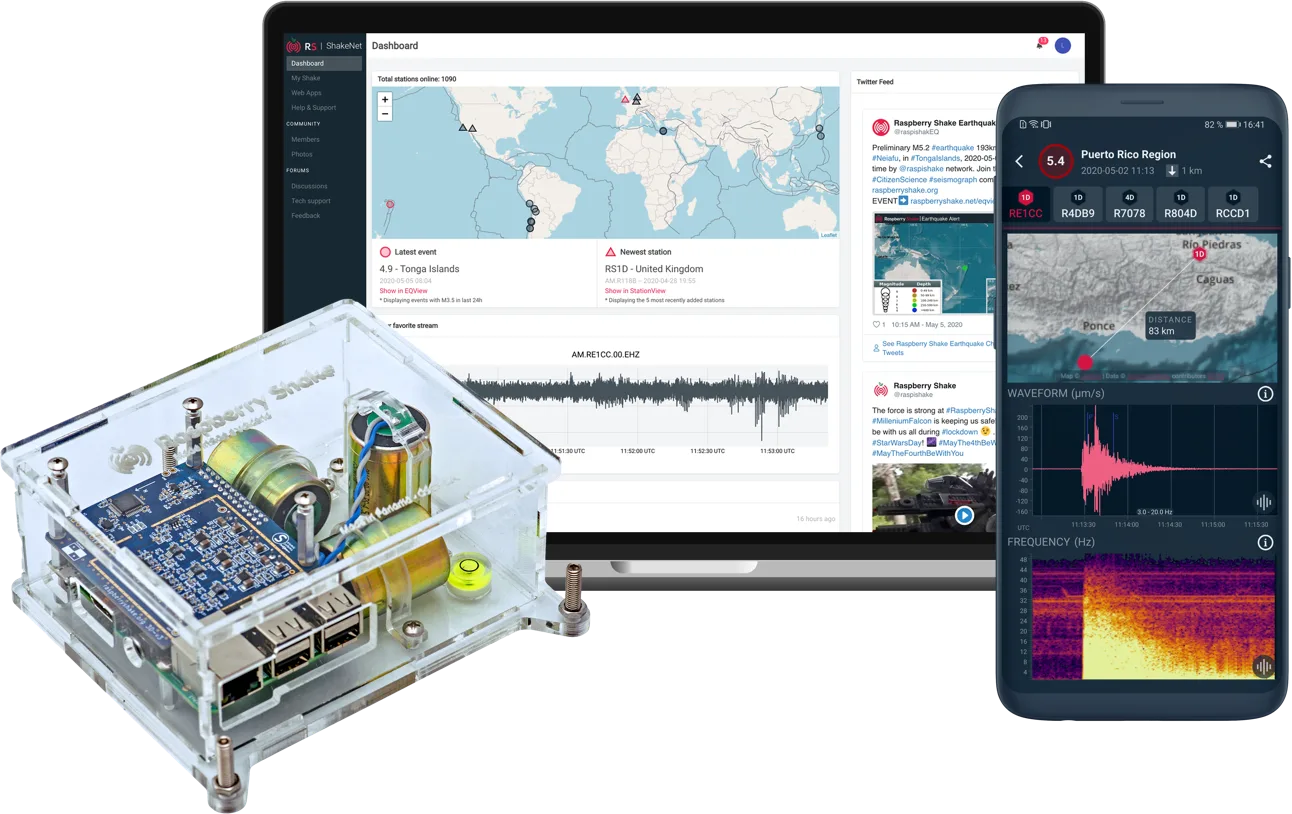
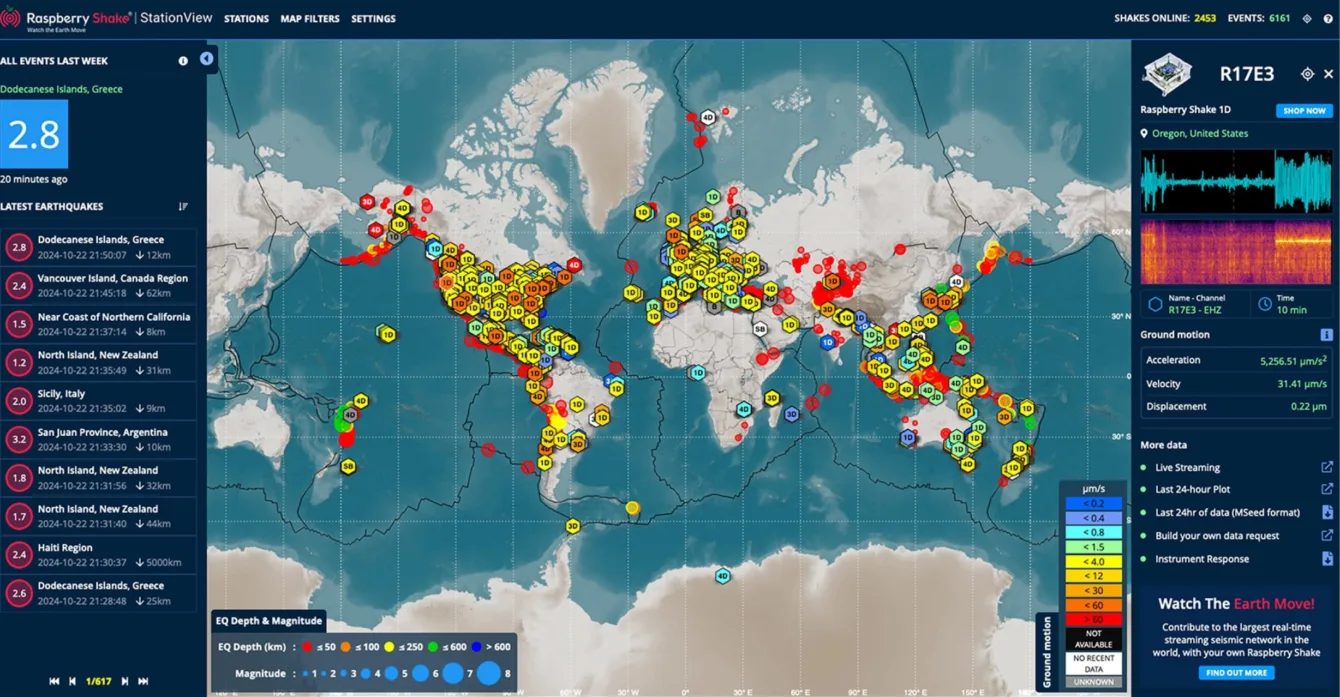
The whole system is plug-and-play: just connect Ethernet and power. It registers automatically with ShakeNet and the data appear in the Station View and Data View web interfaces, where anyone can watch real-time seismograms and spectrograms. There is also the ShakeNet mobile app for iOS and Android.
Models and prices
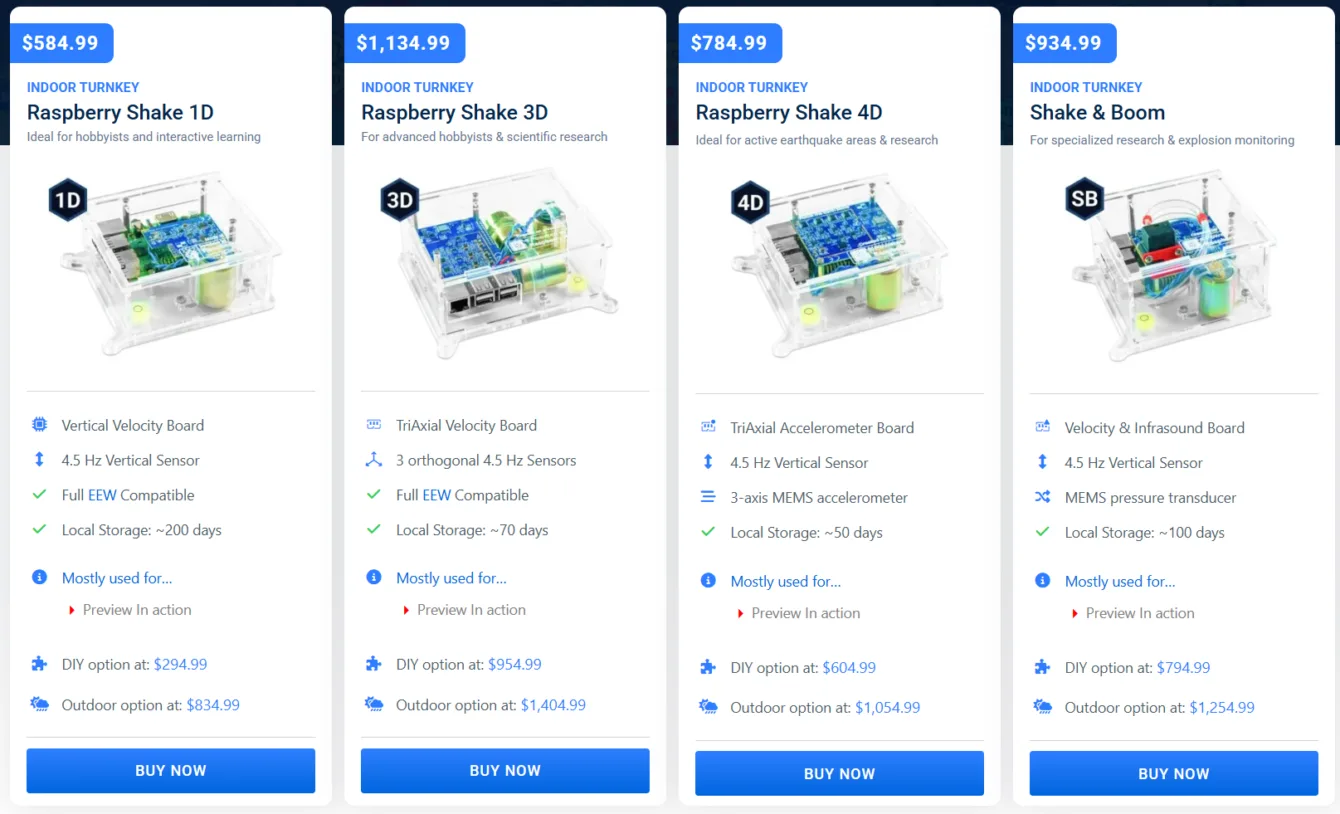
Raspberry Shake offers several models that differ in the number and type of sensors. All of them share the same platform (Raspberry Pi + Shake Board) and access to the free software ecosystem. Worldwide shipping is free on every model, but duties and VAT are not included.
RS1D – vertical seismograph (from $590)
Entry-level model with a single vertical 4.5 Hz geophone. It records up-down ground motion and detects local quakes of any magnitude plus stronger distant events (*). The most affordable choice for hobby use and teaching. Indoor turnkey version is $585, the DIY kit (board + sensor, no Pi, enclosure or accessories) is $295. Outdoor IP67 version costs $835. Local storage holds about 200 days of data.
Note (*): Geophones with a self-resonance of 4.5 Hz are ideal for local and regional events. However, Raspberry Shake uses digital period extension to extend the frequency response to approximately 0.5 Hz (~2 s period), so it can also capture stronger distant earthquakes.
RS3D – three-axis seismograph (from $1,140)
Three orthogonally mounted geophones measure motion in all three axes – vertical plus north-south and east-west. It delivers the highest-quality data and captures S-waves that are harder to see on a single-axis sensor. Best choice for serious research. DIY kit is $955, outdoor version $1,405. Local storage holds roughly 70 days.
RS4D – seismograph + accelerometer (from $790)
Combines a vertical geophone with a three-axis MEMS accelerometer. The geophone catches weak or distant quakes while the accelerometer stays in range during strong local shaking that would saturate the geophone. Ideal for seismically active regions. DIY kit is $605, outdoor version $1,055.
RS&Boom – seismograph + infrasound (from $940)
Pairs a vertical geophone with an infrasound sensor (microbarometer) that measures tiny changes in atmospheric pressure. It detects sounds humans cannot hear – supersonic flights, explosions, volcanic activity or meteors. DIY kit is $795, outdoor version $1,255.
Where to buy
Raspberry Shake is sold exclusively through the official shop at shop.raspberryshake.org. Shipping is free worldwide. Prices are shown without VAT or duties, so expect to add roughly 25 % when importing. The manufacturer also lists a network of resellers on its site.
Installation gotchas
Raspberry Shake is plug-and-play, but data quality depends almost entirely on where and how you mount it. Seismometers are extremely sensitive – even this affordable unit can pick up footsteps, passing cars or a running washing machine.
Placement
Best results come from a ground-floor or basement concrete slab, as far as possible from roads, railways and industrial sites. Wooden floors or upper stories in apartment buildings create too much noise. The quieter the spot, the cleaner the data. Professional stations are usually buried in bedrock; you will not match that at home, but thoughtful placement still helps a lot.
Leveling and stability
The unit must sit perfectly level and rock-solid. Any tilt or wobble distorts the readings. Do not place it on carpet, a wobbly table or a shelf. Concrete or stone tile is ideal. Models with horizontal sensors (RS3D, RS4D) are especially sensitive to leveling errors.
Network connection
Raspberry Shake needs a permanent Ethernet connection. Wi-Fi works but the manufacturer discourages it – the Pi’s Wi-Fi adapter produces RF noise that shows up in the seismic data.
Power and Raspberry Pi compatibility
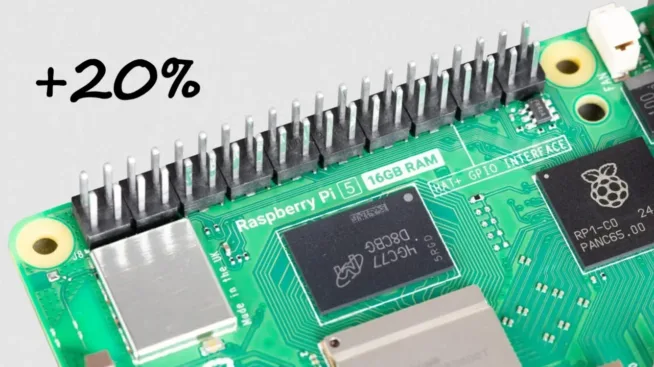
Stable 5 V via micro-USB or USB-C is required. Use a good supply – cheap ones cause dropouts and artifacts. Raspberry Pi 5 is not supported; its extra heat and noise are unnecessary. The Pi Zero is also a poor fit because of high RF interference. Recommended models are the 3B+ and 4B.
Temperature and environment
Geophones are sensitive to temperature swings. Keep the unit away from heaters, direct sunlight and drafts. Stable ambient temperature gives more consistent readings. Outdoor IP67 versions are available for exposed installations.
What Raspberry Shake actually records
These instruments do not only see earthquakes. A home unit picks up a surprising range of vibrations:
- Local earthquakes of any magnitude within a few hundred kilometers
- Distant earthquakes magnitude ~5.0+ from anywhere on the planet
- Traffic – trains, trucks, city buses
- Construction – quarry blasts, heavy machinery, pile driving
- Natural signals – landslides, volcanic activity, distant ocean waves (microseismic noise)
- Cultural noise – concerts, sports events, New Year’s fireworks
Swiss schools running Raspberry Shakes have identified not only quakes but also passing trains, supersonic flights and even the Taylor Swift concert in Zürich in July 2024, where thousands of fans dancing produced measurable ground motion.
Software ecosystem
Raspberry Shake provides a full set of free tools:
- Station View (stationview.raspberryshake.org) – interactive map with live station data
- Data View (dataview.raspberryshake.org) – advanced seismogram and spectrogram visualization
- ShakeNet App – iOS/Android app with earthquake push notifications
- SWARM and jAmaSeis – desktop analysis packages
All data are stored in miniSEED, the seismological standard. Advanced users can pull data via the FDSNWS API or process it in Python with ObsPy.
Use in education
Raspberry Shake is popular in schools and universities. The Swiss Seismological Service at ETH Zürich runs the seismo@school program and has equipped more than 40 Swiss high schools with RS3D units. Students locate quakes by triangulation, analyze seismograms and work with Jupyter notebooks.
Educational discounts and ready-made teaching materials compatible with IRIS resources are available.
DIY alternatives
Raspberry Shake is a polished commercial product, but if you want to build your own seismograph from scratch there are several routes.
Arduino + geophone
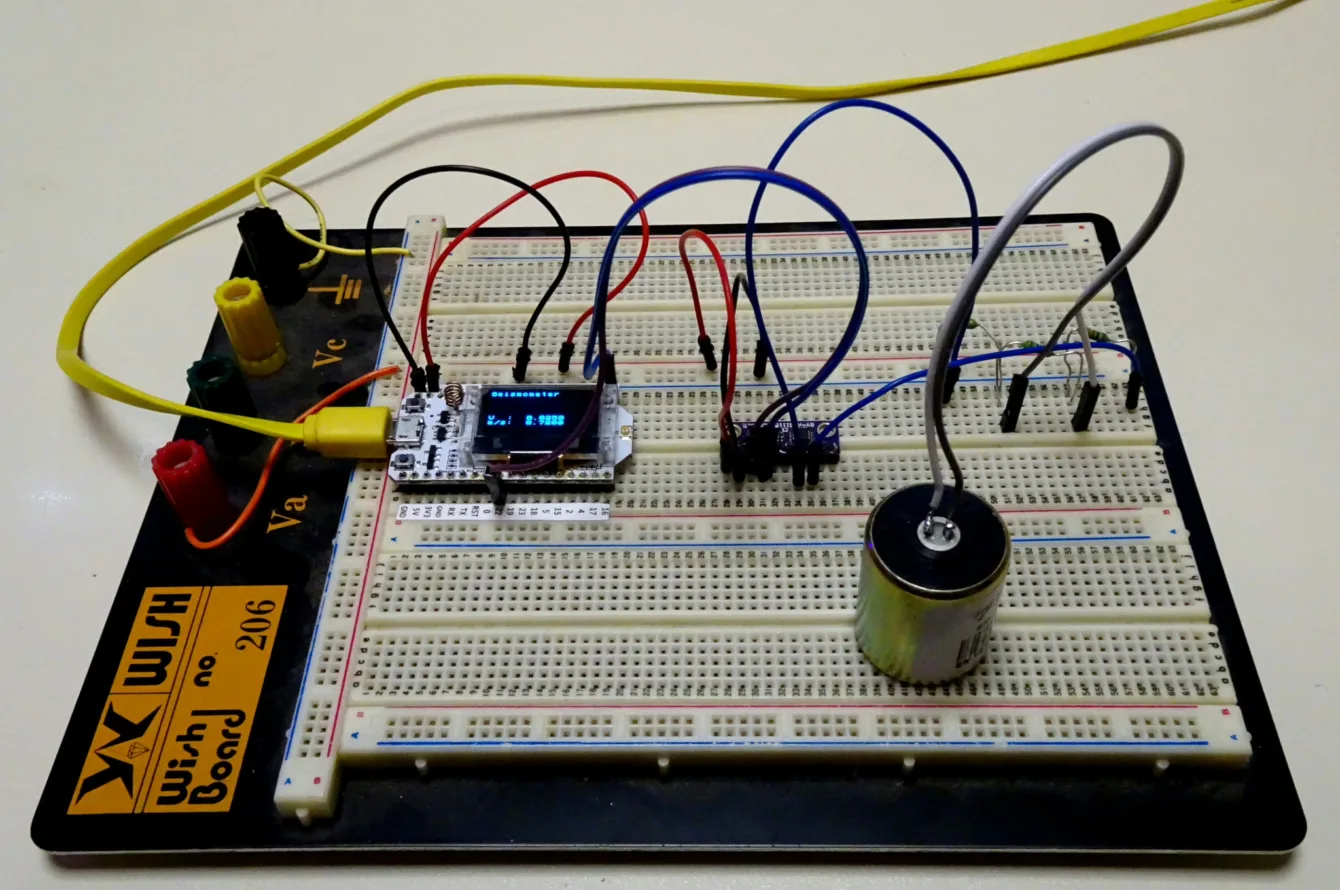
Simplest and cheapest option. A geophone, an LM358 op-amp and an Arduino with ADC give you raw analog data for under $80. No standard format and no connection to the global network, but it is a fun weekend project. I wrote about it here.
Seisberry – open-source seismograph
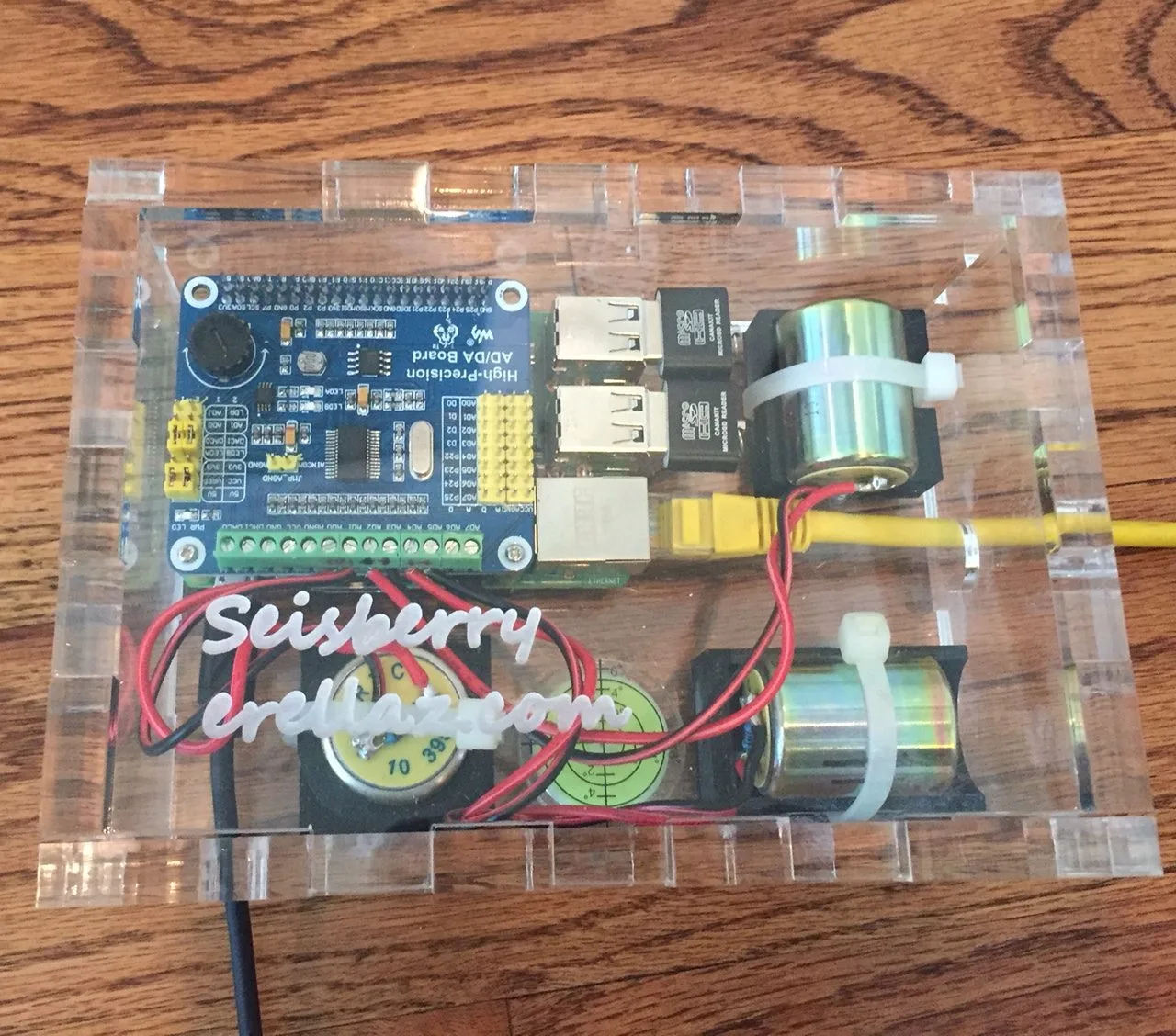
Community project using a Raspberry Pi 3B+, Waveshare High Precision AD/DA board and geophones. Goal is a fully open station that records miniSEED and acts as an IRIS node. Single-component version is under $100, three-component under $160. Code and build guide are on GitHub and erellaz.com.
Long-period seismometer (IEEE Spectrum)
For distant quakes you need a sensor with a lower natural frequency (*). An IEEE Spectrum article describes a compact long-period design (~0.2 Hz) using a Hall sensor and Arduino Nano that can catch those distant events. It is larger (~60 cm diameter) but far more sensitive at low frequencies.
Note (*): Geophones with a self-resonance of 4.5 Hz are ideal mainly for local and regional events. However, Raspberry Shake uses digital period extension to extend the frequency response to approximately 0.5 Hz (~2 s period), so it can also capture stronger distant earthquakes.
ESP32 + MEMS accelerometer
Quick-and-dirty option: an ADXL345 or MPU6050 on an ESP32. Extremely cheap and tiny, but MEMS sensitivity is orders of magnitude lower than a geophone. You will see strong local shaking but miss weak or distant events. Fine as a vibration alarm, not really a seismograph.
Similar citizen-science projects
Raspberry Shake is not the only project where volunteers with inexpensive hardware build global monitoring networks. Here are a few others that connect makers, scientists and enthusiasts.
Blitzortung – lightning detection
Blitzortung is a global non-profit lightning detection network started in Germany in 2005. It now has about 6,500 stations worldwide. Each participant builds a VLF antenna + GPS receiver (~$330) that timestamps strikes to microseconds. Data feed popular apps such as Windy and Lightning Maps.
Sensor.Community – air quality
Sensor.Community (formerly Luftdaten) began in Stuttgart in 2016 with 300 sensors and now has over 10,000 active stations, mostly in Europe. A cheap PM2.5/PM10 sensor on an ESP8266 or ESP32 pushes data to a public map. Build cost is a few tens of dollars; the project is beginner-friendly.
TinyGS – satellite ground station
TinyGS is an open network of ground stations for LoRa satellites, weather sondes and other spacecraft. Started in 2019 as a weekend experiment, it has grown into a worldwide mesh. Hardware is minimal – an ESP32 LoRa board (e.g. Heltec WiFi LoRa 32) plus an antenna. Firmware flashes in one click; you are receiving CubeSat telemetry within minutes.
Safecast – radiation monitoring
Safecast is a volunteer non-profit that maps radiation and other environmental data. Founded the day after the 2011 Fukushima disaster, it has collected over 120 million measurements and maintains the world’s largest open radiation-background database. The main tool is the open-source bGeigie Nano mobile Geiger counter. All data are released under CC0.
What these projects share is the idea that affordable hardware in the hands of thousands of volunteers can create monitoring networks whose density and coverage often surpass official infrastructure. For makers it is a great way to turn a hobby into real science.
My take:
Raspberry Shake sits at the intersection of citizen science and hobby electronics. For a few hundred dollars you get a real seismograph, access to a global network and professional-grade software. Even in a relatively quiet seismic region like ours it is a fascinating window into what is happening under our feet.
If the project interests you, start at the official site raspberryshake.org. Before buying, browse the live station map at Station View to see what real data look like. If you want to experiment on a minimal budget first, try one of the Arduino + geophone builds.
Another good read is this ETH Zürich PDF.