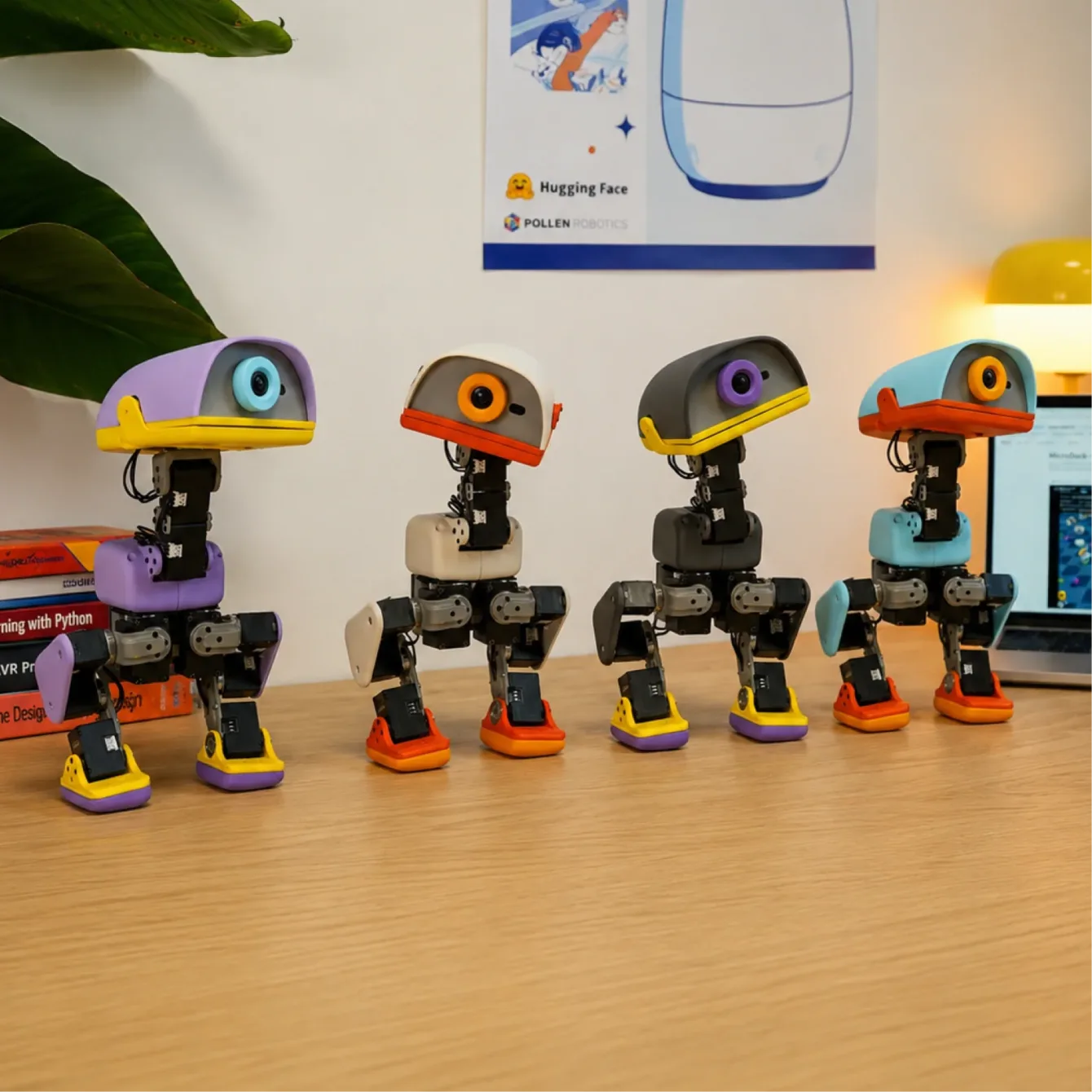
A small robot for ten thousand usually means a handful of pre-programmed moves and a phone app, and that’s basically it. Not so with Microduck – a compact duck-shaped robot priced at $399 in pre-order, roughly nine thousand crowns before VAT and duties.
Walking or getting back up after a fall isn’t scripted. The motion is trained in simulation and the finished network is loaded onto the robot. The whole pipeline and the control software are open source, so you can train your own behaviors.
And that’s more interesting than the duck shape.
What it can do
Out of the box you drive it with the included gamepad. It walks, sits, stands up, kicks a ball, picks up objects with its beak, and rights itself after a fall. Snap on the wheels and it switches to a different trained policy and rolls around.
It reacts to a laser pointer and NFC tags that can trigger actions.
It doesn’t speak. It makes sounds and on first boot it generates its own vocal fingerprint that stays with it. Besides locomotion it has a few entertainment modes – theremin, or choral singing when several units are together.
Races, robot soccer or mutual reactions are a cheap way to test group behavior without a lab full of hardware – Microduck can do that too.
The real point of the product is development. Compared with the competition it’s one of the cheaper robots, yet it opens the door to a higher level of programming, machine learning and AI.
What’s inside
Microduck isn’t run by a microcontroller but by a Linux SoC. The Rockchip RK3566 has four Cortex-A55 cores, Mali-G52 graphics and an NPU rated around 0.8 TOPS. Pollen lists only “AI accelerator” in the table; the rest comes from the Rockchip datasheet. Add 1 GB RAM and 32 GB storage.
Fifteen servos and an IMU round it out.
Running a trained network is within its reach; training happens on your own machine or via Hugging Face Jobs.
Sensors:
- front camera with recording indicator
- two IMUs, one in the body and one in the head
- depth sensor and 8×8 ToF array
- microphones and speaker
- two NFC antennas, one in the head and one in the beak
- Wi-Fi and Bluetooth
Dimensions 25 × 14 cm, weight under 800 g, 15 degrees of freedom split across legs, head and neck. The beak is articulated and can lift objects from the ground.
Power comes from a removable NP-F550 camera battery, 2600 mAh, good for about an hour of runtime.
Training
Motion is trained in MuJoCo with PPO, exported to ONNX and flashed to the robot. If something is off you go back to simulation and try again.
The training tools live in the separate repo pollen-robotics/microduck_rl, the control software in pollen-robotics/microduck, both under Apache 2.0.
The simulator runs in the browser, so you can try the whole workflow before ordering anything.
What we know so far
Microduck is still in pre-order. The original plan was a Christmas launch, but demand has pushed the timeline out to 4–6 months.
Only the software side is open source; the hardware is not.
The full spec is still not 100 % locked down – camera resolution and field of view, rangefinder range, radio variants and SDK languages are still unclear. The site mentions LiDAR while other articles only talk about ToF.
The site promises seven trained behaviors but lists only six: walking, sit/stand, kick, beak grasp, wheeled driving and recovery from a fall. The seventh remains undisclosed.
The architecture docs describe the target first-production version. The current runtime prototype is marked experimental in the repo and is expected to be rewritten.
One more note: the domain microduck.net has nothing to do with the robot; it’s an unrelated crypto token. The official site is pollen-robotics.com.
Macroduck, clone in development
Microduck drew attention fast. On 31 August Andrea Esposito posted on X about Macroduck, claiming he reverse-engineered Microduck in a single day and promising delivery in roughly four weeks instead of the multi-month wait.
So far only an Onshape assembly is visible at macroduck.bot. No finished unit, no electronics. Entry into the free-unit giveaway requires following the author on X and submitting an email; releasing the BOM, CAD and assembly instructions is conditional on sufficient interest.
The reverse engineering covers only the mechanics. Microduck’s control software is Apache 2.0 and can be used, but Pollen never published the mechanical files, so the part geometry is the author’s own work. Until photos of a working unit appear, it’s still just a promise.
Open alternative
If you want to build, there’s a fully open project including hardware. Open Duck Mini v2 is a miniature version of Disney’s BDX droid, about 42 cm tall, runs on a Raspberry Pi Zero 2 W and targets under $400 in parts.
Its author, Antoine Pirrone, is also part of the core Microduck team. Print instructions, bill of materials and a Discord community are available.
Already the second robot
Microduck is the second robot from Pollen Robotics. The first was Reachy Mini.
Links: Pollen Robotics, GitHub, Shop