Nucleo STM32L476 – high performance and low-power consumption

All processor manufacturers want low-power consumption or high performenace. Now, ST Microelectronics shows a new type of processor – STM32L476 which combines high performance and low-power consumption.

This type of processor contains various peripherals.

The website chiptron.cz, the first of all, owns this processor with development board Nucleo.

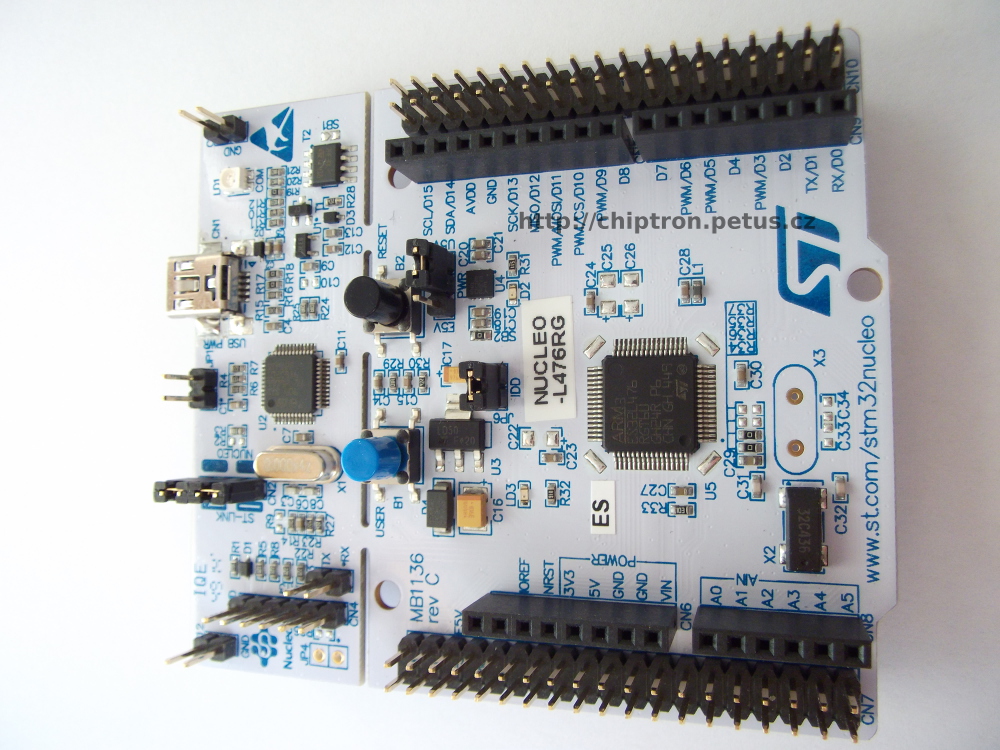
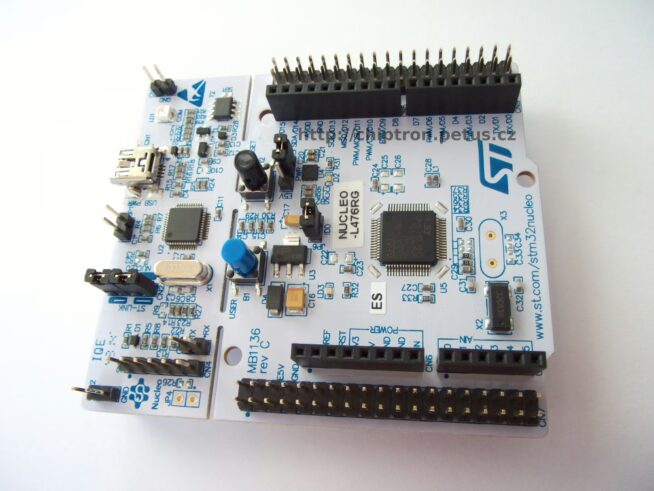
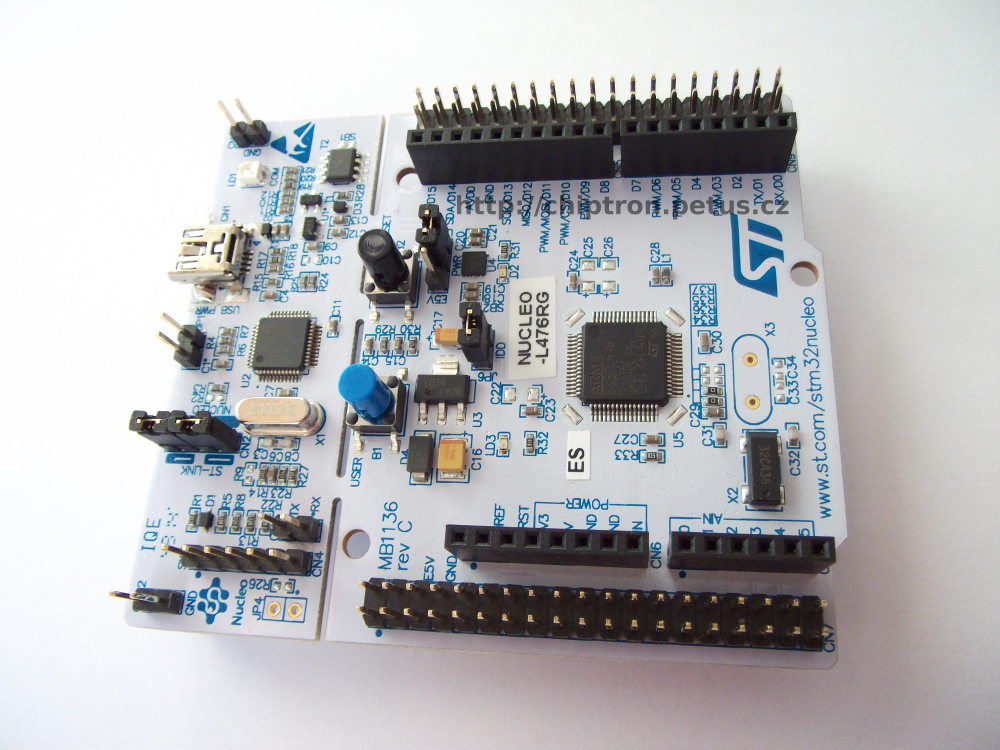
What do you can find on this development board? Nucleo is family of development boards. It means that Nucleo is the same as different Nucleos with different processors.

– programmer/debugger ST/LINKv2

Arduino? like connectors and ST Morpho connectors

– 2 buttons (USER and RESET)

– 2 LED diods

And why this processor is better than others?:

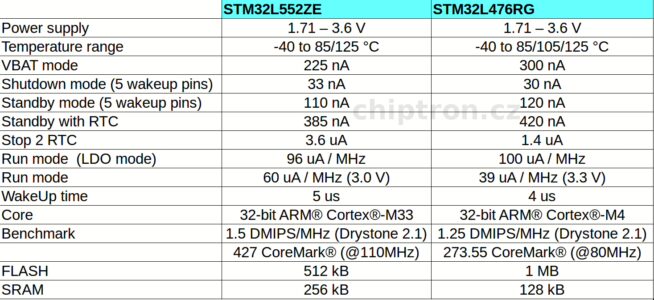
ARM? CORTEX?-M4 80MHz

– 1 MB FLASH, 128KB SRAM

3x 12-bit ADC (5 MSPS)

– two comparators

– two operational amplifiers

– two DAC channels

– an internal voltage reference buffer

– low-power RTC

– two general-purpose 32-bit timer

– two 16-bit PWM timers dedicated to motor control

– seven general-purpose 16-bit timers

– and two 16-bit low-power timers

– the STM32L476 supports four digital filters for external sigma delta modulators (DFSDM)

– 24 capacitive sensing channels

– LCD driver 8×40 or 4×44, with internal step-up converter

and next advantages?

1.71 V to 3.6 V power supply

300 nA in VBAT mode: supply for RTC and 32×32-bit backup registers

30 nA Shutdown mode (5 wakeup pins)

– 130 nA Standby mode (5 wakeup pins)

1.1 ?A Stop 2 mode, 1.4 ?A Stop 2 with RTC

100 ?A/MHz run mode

100DMIPS/1.25DMIPS/MHz

– 14-channel DMA controller

– 2x SAIs (serial audio interface)

– 3x I2C FM+(1 Mbit/s), SMBus/PMBus

– 6x USARTs (ISO 7816, LIN, IrDA, modem)

– 3x SPIs (4x SPIs s Quad SPI)

– CAN (2.0B Active) a SDMMC interface

– true random number generator

and more…

photogalery:
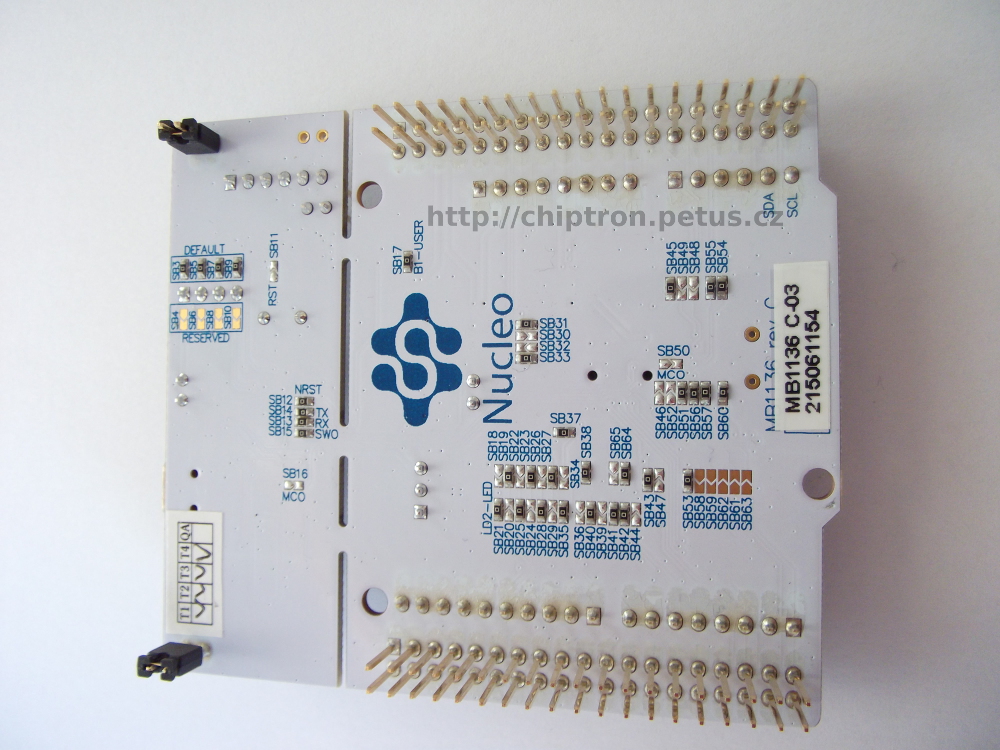
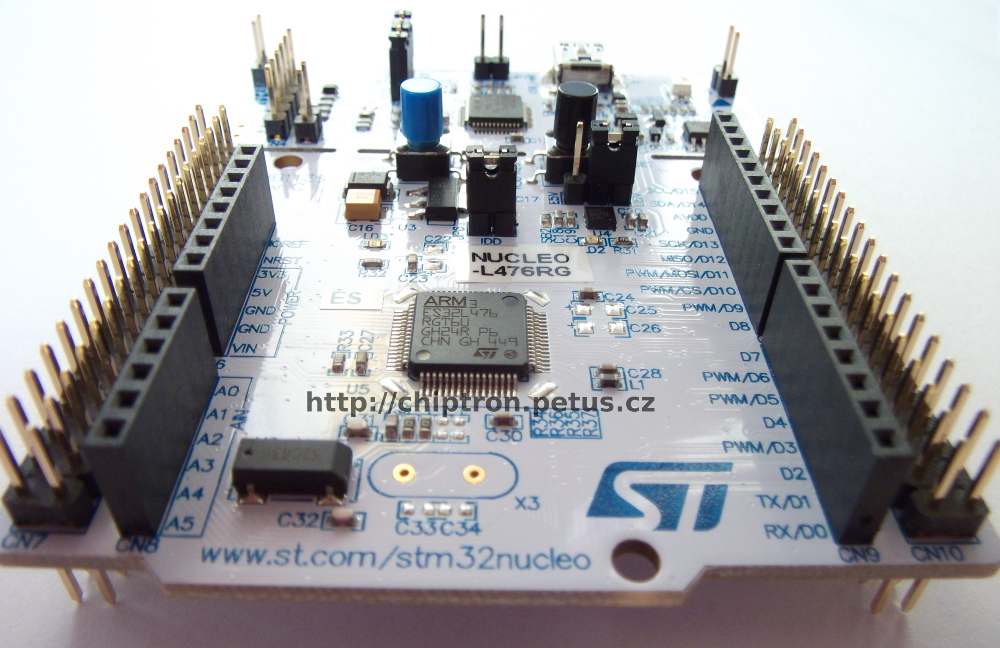
Nucleo-STM32L476

Nucleo-STM32L476

Nucleo-STM32L476

Nucleo-STM32L476

Nucleo-STM32L476

Nucleo-STM32L476

Quick view of STM32L476.

Share the article:
Tags:
Show your
Maker soul!
Buy a T-Shirt
Coffee for Chiptron
Give a boost to the next article

Related Articles

The STM32 family of ultra low-power microcontrollers made by STMicroelectronics welcomed a new line of ultra low-power microcontrollers called STM32L5. The most siginificant change is using of different ARM Core. STM32L5 contains ARM Cortex-M33 instead of Cortex M0+ and M4.…

STM32 Nucleo – this is a new name for development boards by ST Microelectronics. These development boards are available: NUCLEO-F103RB, NUCLEO-L152RE, NUCLEO-F401RE, NUCLEO-F030R8 (and NUCLEO-F072RB). If you take notice, the microcontrollers are from F4, F1, F0 and L1 series. The…

And here it is! If you heard about Nucleo-144, then it’s true! STMicroelectronics released new development board called STM32 Nucleo-144 (STM32 in LQFP144 package). Extension of “Nucleo development board family” is totally logical step to possibility of using another peripherals…

AVR, ATMega, ATTiny, PIC, Arduino… these are very searching words in google and I asked myself “Why?”. Yes, AVR by Atmel or PIC by Microchip family is popular, but we can program better (modern, faster, more low-power, more peripherals) microcontrollers…

A new member to STM32F7 family (e.g. also STM32F746 and STM32F769). STM32F723. STM32F723 is based on ARM? Cortex?-M7 32-bit RISC core with up to 216 MHz frequency. The microcontroller includes 512 kB FLASH and 256 kB SRAM. Clock, reset and…

STMicroelectronics released the first microprocessor (don’t confuse with microcontroller). The new family of micoprocessor is called STM32MP1. The STM32MP1 combines ARM® Cortex®-A7 32-bit RISC @650 MHz and ARM® Cortex®-M4 @209 MHz. The key features are Arm® NEONâ„¢ and Arm® TrustZone®,…

Trends