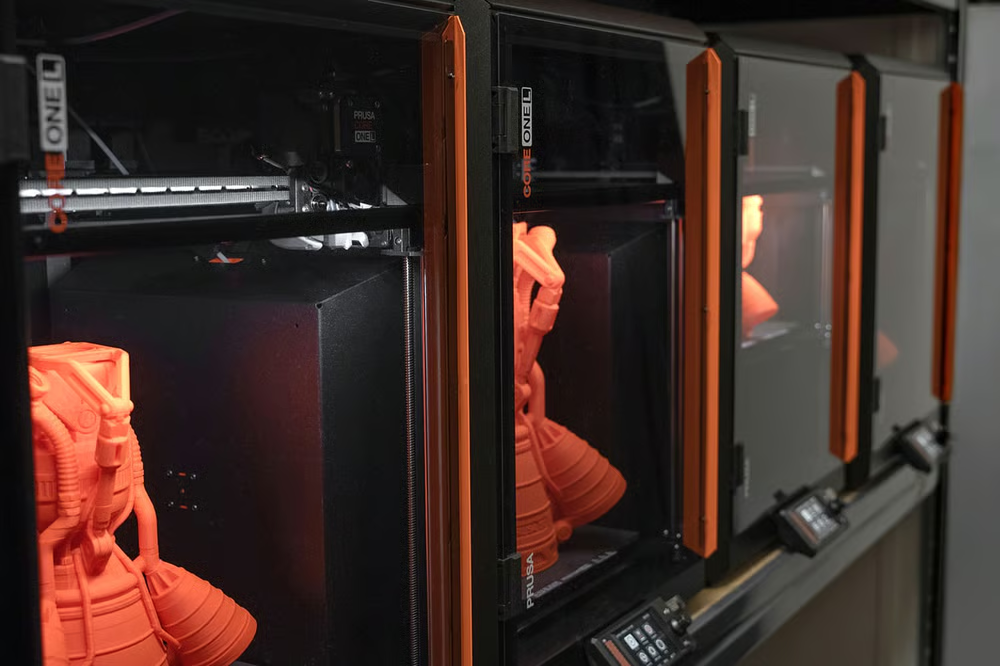
I’ve been watching Prusa Research team up with Swedish Bondtech to kick off pre-orders for the INDX conversion kit on CORE One/+ printers. This isn’t some half-baked MMU knockoff for swapping filaments. It’s a full architecture that leaves even the Bambu Lab Vortek in the dust – across multiple key specs, no less.
INDX Architecture: Smart Head, Passive Tools
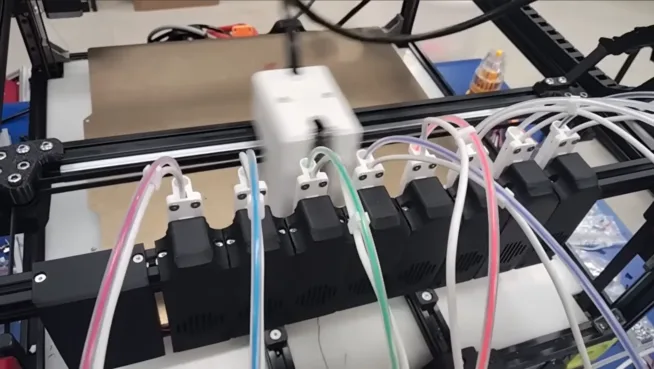
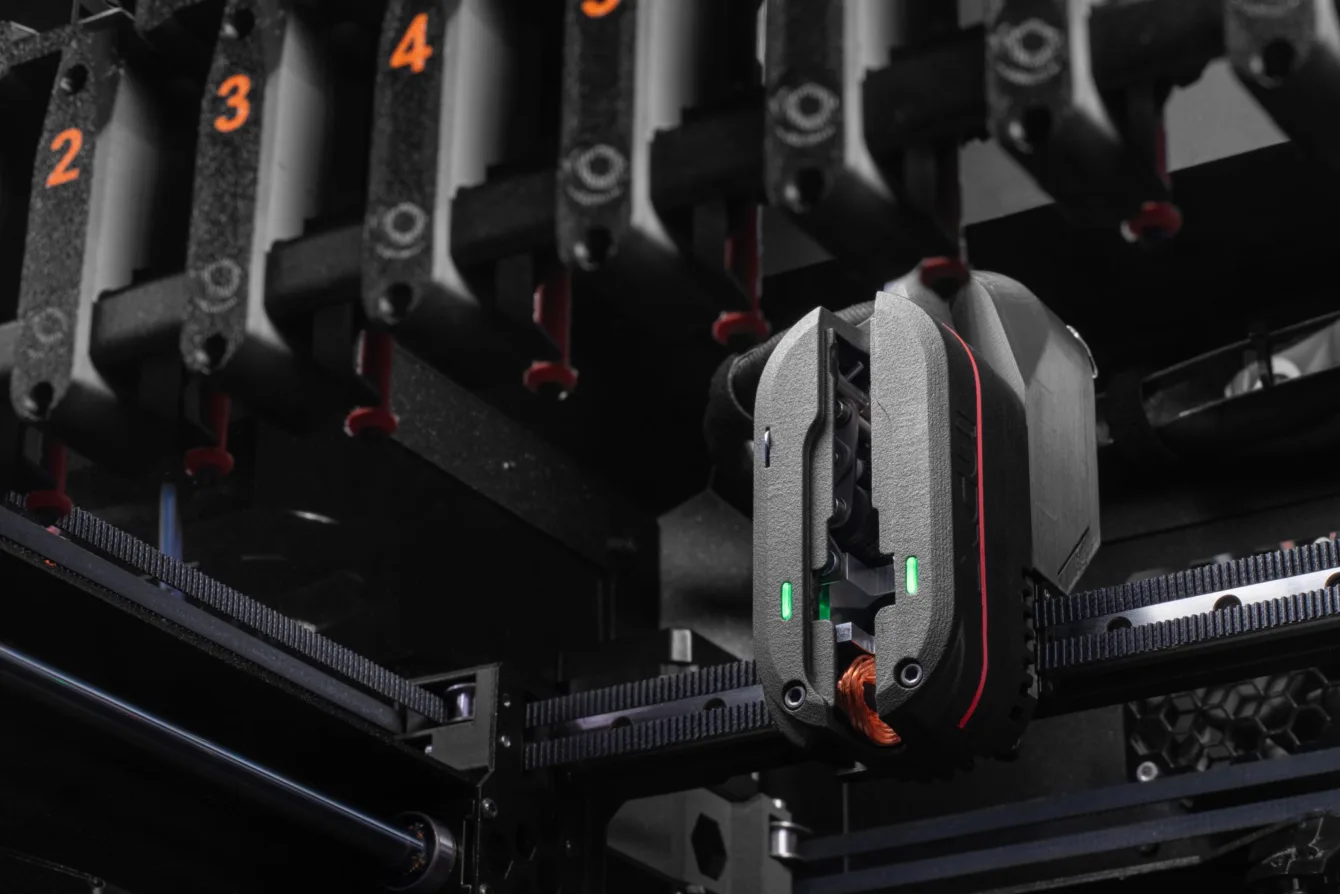
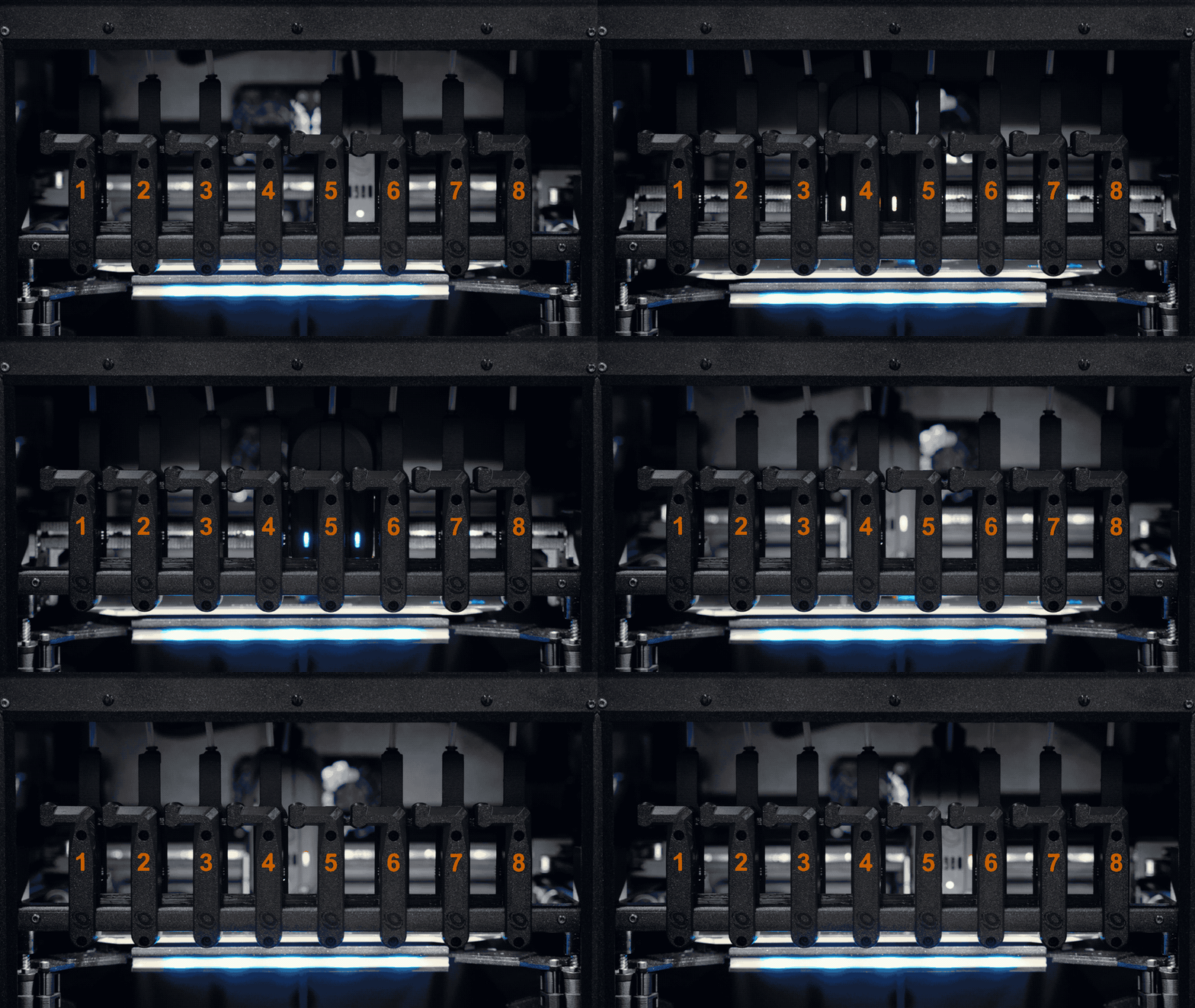
INDX builds around one active print head packing all the brains – inductive coil for heating, extrusion via Bondtech’s Dynamic Dual Drive, and control logic. The passive tool heads have zero electronics – basically just a heatbreak plus nozzle in a holder. The active head grabs a passive tool from the dock, locks it in mechanically, and starts heating on the spot.
That’s a huge leap from classic toolchangers like the Prusa XL, where every head hauls its own extruder, motor, fans, and peripherals. INDX tools are lightweight, cheap, and compact – that’s why you can fit up to 8 on a CORE One.
Each tool has its own dedicated filament path. The filament stays loaded permanently – no retraction, no cutting. That’s the big edge over Bambu’s Vortek, which pulls and reloads filament every swap.
Inductive Heating: No Heat Block, No Inertia
The INDX active head has an inductive coil running on high-frequency magnetic fields. Once it picks up a tool from the dock, it heats the nozzle inductively – no physical contact, no connectors.
There’s no traditional heat block on INDX – it doesn’t exist. The nozzle itself acts as the heating element with minimal mass and near-zero thermal inertia. Heating from cold to print temp takes just seconds. And crucially, it cools just as fast. That kills oozing on parked tools, since inactive nozzles are literally cold.
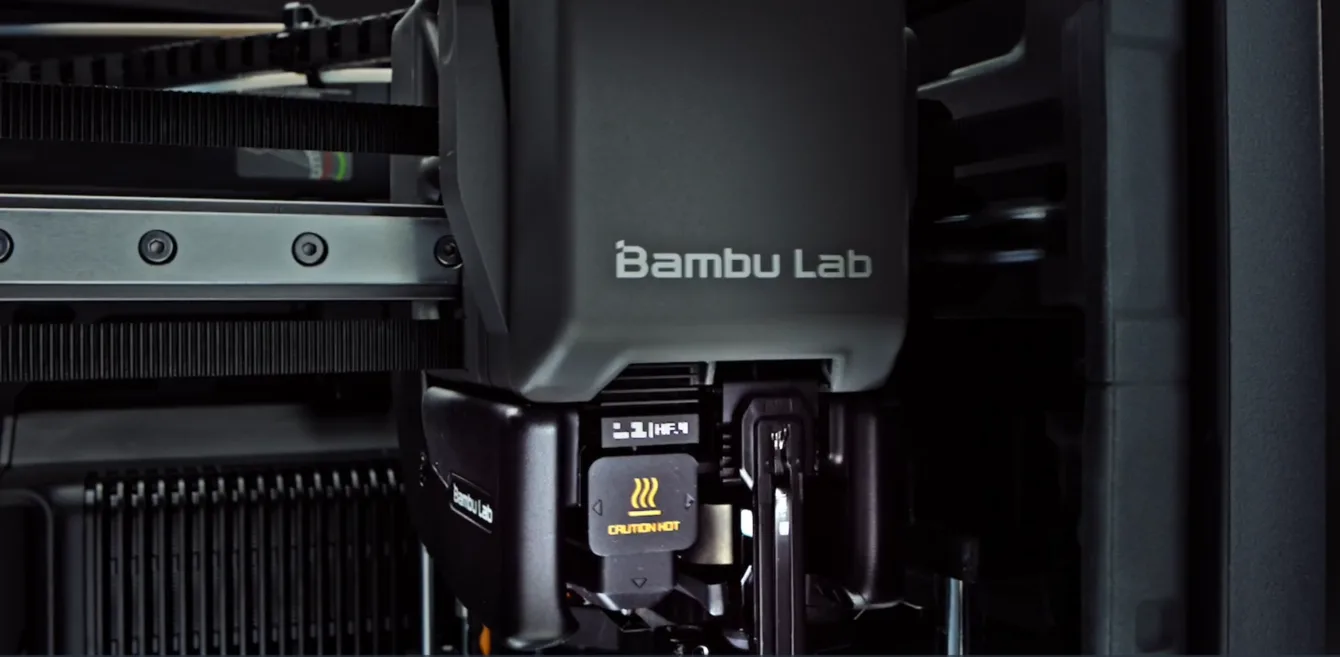
Bambu’s H2C Vortek uses inductive heating too, promising 8 seconds from room temp to print temp. The principle’s similar, but the architecture’s worlds apart – Vortek swaps entire hotends, not passive tools.
Tool Changes: INDX vs. Vortek vs. Snapmaker
This is where multi-material print times get real. Each system handles swaps differently:
Prusa INDX is a true toolchanger – the active head parks the current tool in its dock and grabs a new one. Filament stays loaded, nothing retracts, nothing cuts. Current swap time is about 15 seconds, though Prusa aims to trim it to 8–10 seconds with future firmware tweaks.
Bambu Vortek (H2C) isn’t technically a toolchanger; it’s a hotend swapper. The active head has to retract filament every time, park the hotend on the rack, pick up a new one, heat it, and reload filament. Bambu quotes 8 seconds for inductive heating, but full swap cycles – including retraction and loading – clock in at 15–30 seconds per community tests and breakdowns. Some sources peg complex setups at 40–45 seconds. Tom’s Hardware straight-up says in their H2C review that Vortek’s speed doesn’t match true toolchangers.
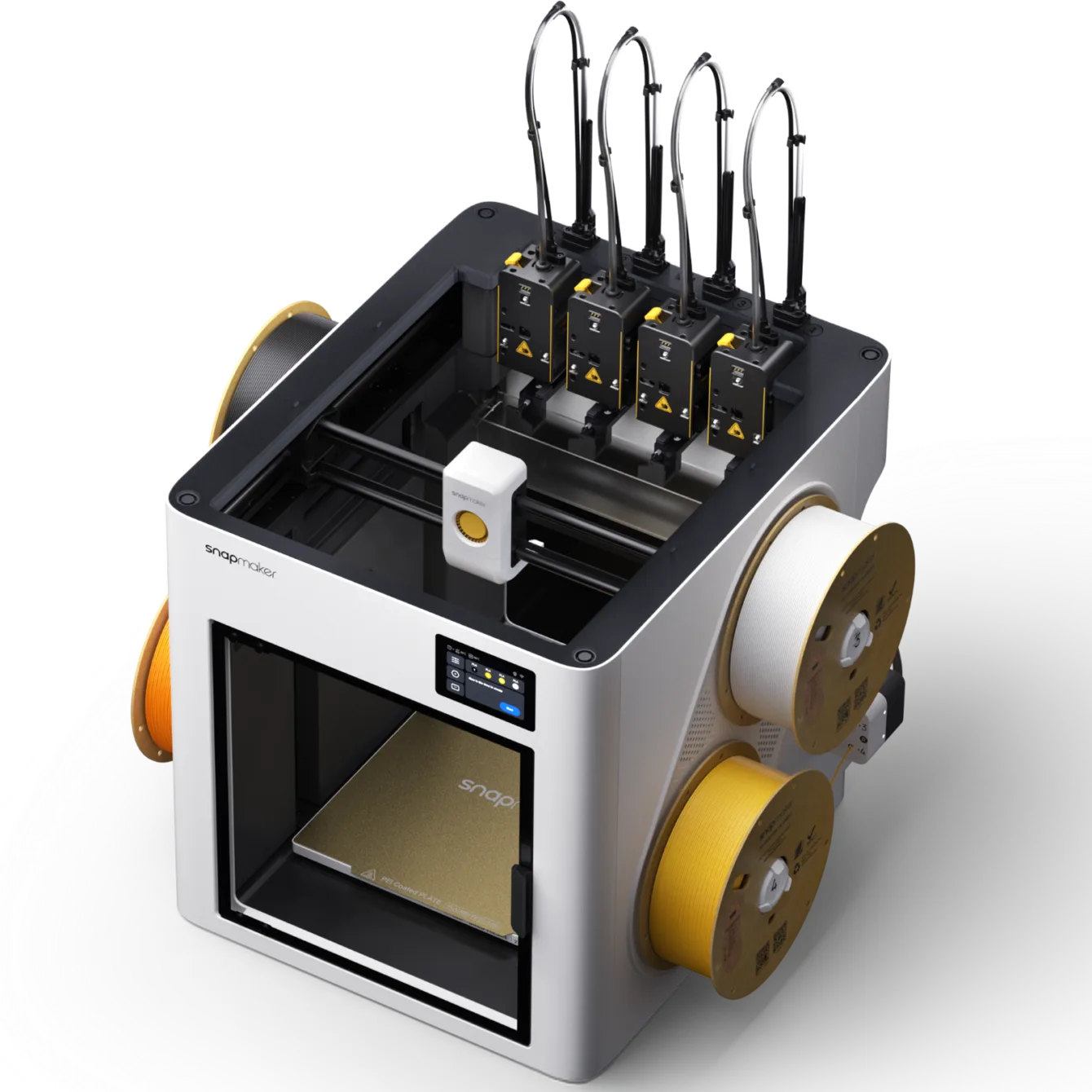
Snapmaker U1 is also a true toolchanger with 4 tool heads. The SnapSwap system uses kinematic mounts with steel balls – swaps take roughly 5 seconds. No filament retraction, but unlike INDX, the heads have their own heating elements and stay preheated, so no wait for warmup.
It’s basically the same setup as the Prusa XL.
| Parameter | Prusa INDX | Bambu H2C Vortek | Snapmaker U1 |
|---|---|---|---|
| System Type | Toolchanger (smart head + passive tools) | Hotend swapper | Toolchanger (preheated heads) |
| Number of Tools | 4 or 8 | 6 Vortek + 1 fixed (7 total) | 4 |
| Swap Time (Cycle) | ~15 s (target: 8–10 s) | ~15–30 s (real-world up to 40–45 s) | ~5 s |
| Filament Retraction on Swap | No | Yes | No |
| Purge Waste | Almost none | None (up to 7 mats.), AMS purge over 7 | Minimal |
| AMS / External Feeder Needed | No – filament stays loaded | Yes (AMS 2 Pro) | No |
| Tool Heating | Inductive (on the fly) | Inductive (~8 s) | Preheated (constant) |
| Automatic Extruder Pressure | Yes (Dynamic Dual Drive) | No | No |
| Enclosed / Heated Chamber | No | Yes (65 °C) | Optional |
Why Filament Retraction Sucks on Vortek
Vortek has to fully yank the filament from the hotend module on every swap, park the hotend in its holder, grab a new one, heat it, and feed filament back in. That brings a few headaches:
- AMS Dependency – filament shuttles back and forth, so Vortek demands an AMS 2 Pro as an external feeder. INDX? Doesn’t need one.
- Longer Swap Cycles – as Tom’s Hardware put it, Vortek’s speed just can’t keep up with true toolchangers. With prints involving dozens or hundreds of swaps, those gaps add up fast.
- Mechanical Complexity – cutting and reloading filament needs precise mechanics. Every extra moving part is a failure waiting to happen.
- Locked to Proprietary Hotends – Vortek’s inductive hotends have built-in smart chips and won’t play nice with third-party stuff. INDX uses standard nozzles.
INDX skips all that – filament stays put in the tool, no spool juggling, no cutting.
Dynamic Dual Drive: Automatic Pressure
The INDX extruder runs Bondtech’s Dynamic Dual Drive with on-the-fly pressure adjustment for the feed wheels. Soft stuff like TPU or TPE needs lighter grip than stiff carbon or glass composites. INDX handles it automatically.
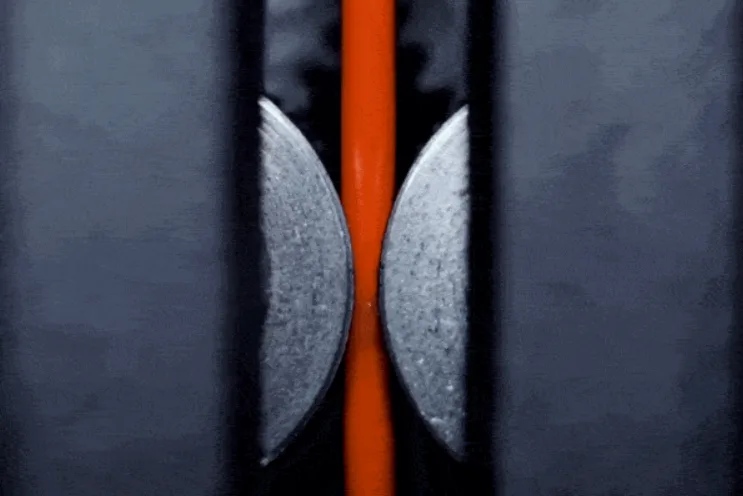
Neither Vortek nor Snapmaker U1 offers this. On those, you’ll tweak pressure manually or risk issues mixing filaments with different diameters.
Tool Calibration: Eddy Current Sensor vs. XL Pin
INDX brings a fresh calibration system based on an eddy current sensor, mounted permanently outside the print area. It detects nozzle position quickly and accurately – calibrating one tool takes just 15 seconds. For context, Prusa XL’s PIN system calibration ran hundreds of seconds. Prusa calls this new setup roughly 20× faster.
A second sensor constantly scans the background to cut noise, boosting repeatability in any environment.
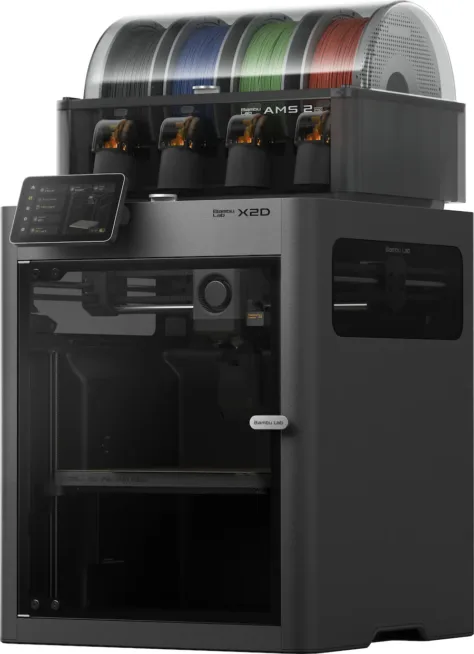
Bambu Lab X2D: Different Beast
X2D (unveiled April 14, 2026) succeeds the legendary X1 Carbon, but it’s technically a dual-nozzle system, not a toolchanger. The primary nozzle (direct drive, up to 1000 mm/s) prints the model, while the secondary (Bowden, max 200 mm/s) usually lays down support material.
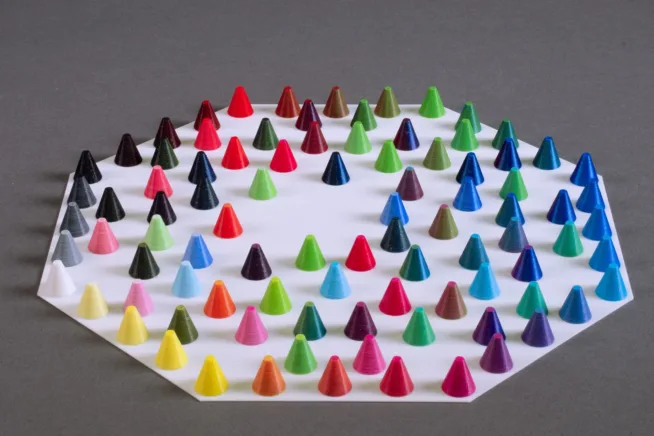
Nozzle switching is mechanical (gear-and-trigger, no extra motor) and quick. But max 2 materials at once is a core limitation. With AMS 2 Pro, you can swap up to 25 colors, but expect purge waste.
Starts at $649 (base) / $899 (Combo with AMS 2 Pro). Active chamber heating to 65 °C, LiDAR, Vision Encoder, Flow Dynamics Calibration. Build volume 256 × 256 × 260 mm.
Snapmaker U1: Direct Rival, Half the Capacity
Snapmaker U1 is a true toolchanger with 4 independent heads on a CoreXY base. Build volume 270 × 270 × 270 mm, speeds up to 500 mm/s, acceleration 20,000 mm/s².
SnapSwap uses kinematic mounts with steel balls – mechanically slick, tested over 1,000,000 cycles. Each head carries its own hotend with preheat, so swap times are the shortest here (~5 s). Runs Klipper firmware, RFID filament detection.
Price ~$980 for the full machine including all 4 heads. It pulled in over $20 million on Kickstarter in 2025.
Drawbacks: only 4 tools (INDX offers 8), no inductive heating, no auto pressure, enclosed chamber optional at best.
Full Setup Cost Comparison
A fair comparison needs total costs for a working multi-material rig:
| Setup | Approx. Price | What You Get |
|---|---|---|
| CORE One+ + INDX 8-tool | ~$2,700 (printer + kit) | 8 tools, 0 purge, inductive heating |
| Bambu H2C Vortek Combo | ~$2,500–$3,200 | 7 materials, 0 purge (up to 7), heated chamber, AMS |
| Snapmaker U1 | ~$1,000 | 4 tools, minimal purge, full machine |
| Bambu X2D Combo | ~$1,000 | 2 nozzles, heated chamber, AMS, LiDAR |
Who Should Grab INDX?
My take: INDX shines for makers and pros who routinely mix more than 4 materials, swap nozzle sizes (0.25–0.8 mm), and hate manually swapping tools per project. Load 8 spools, set your nozzles, and let the printer handle the rest.
The conversion kit comes in two flavors:
- Prusa INDX Conversion Kit – shipping from June 2026, with 8 tool heads featuring hardened 0.4 mm nozzles.
- Bondtech INDX Founders Edition – exclusive version, first units from May 2026.
Sources: