Teensy 3.5 & 3.6

The name of Teensy is well-known.

After Teensy 1.0 and 2.0, which included microcontroller by Atmel company (AT90USB162 v1.0 and ATMega32U4 in v2.0) came the first kickstarter’s Teensy 3 in 2012. It included 32 bit microcontroller.

Then (2014) the world saw Teensy 3.1 and 3.2.

If you still don’t know what Teensy is, so, it is development board which is supported in Arduino IDE.

Specifications of Teensy 3.5 and 3.6.
Teensy 3.5

– 120 MHz ARM Cortex-M4 with Floating Point Unit

– 512K Flash, 192K RAM, 4K EEPROM

– Microcontroller Chip MK64FX512VMD12 (PDF link)

– 1 CAN Bus Port

– 16 General Purpose DMA Channels

– 5 Volt Tolerance On All Digital I/O Pins

Teensy 3.6

– 180 MHz ARM Cortex-M4 with Floating Point Unit

– 1M Flash, 256K RAM, 4K EEPROM

– Microcontroller Chip MK66FX1M0VMD18 (PDF link)

– USB High Speed (480 Mbit/sec) Port

– 2 CAN Bus Ports

– 32 General Purpose DMA Channels

– 11 Touch Sensing Inputs

Both specifications:

– 62 I/O Pins (42 breadboard friendly)

– 25 Analog Inputs to 2 ADCs with 13 bits resolution

– 2 Analog Outputs (DACs) with 12 bit resolution

– 20 PWM Outputs

– USB Full Speed (12 Mbit/sec) Port

– Ethernet mac, capable of full 100 Mbit/sec speed

– Native SD card port

– I2S Audio Port, 4 Channel Digital Audio Input & Output

– 14 Hardware Timers

– Cryptographic Acceleration Unit

– Random Number Generator

– CRC Computation Unit

– 6 Serial Ports (2 with FIFO & Fast Baud Rates)

– 3 SPI Ports (1 with FIFO)

– 4 I2C Ports

– Real Time Clock

The 3.5 version costs $23/pc, 3.6 version $28/pc.

Kickstarter: https://www.kickstarter.com/projects/paulstoffregen/teensy-35-and-36

Share the article:
Tags:
Show your
Maker soul!
Buy a T-Shirt
Coffee for Chiptron
Give a boost to the next article

Related Articles

The development boards are very popular. I decided to share this list. These boards are interesting, popular and cheap (to 30? – by farnell.com). If you click on the picture, you will be redirected in eshop, where you can buy…

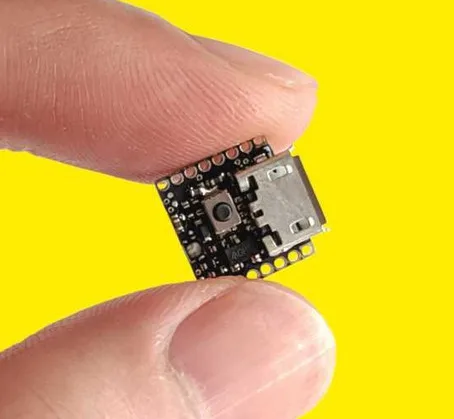
The smallest Arduino board – the Pico and Atom X1 tried to be the smallest Arduino board, but in this time we have a new winner – ATTO. ATTO is really miniature, the size of board is 11.5 x 10.3…

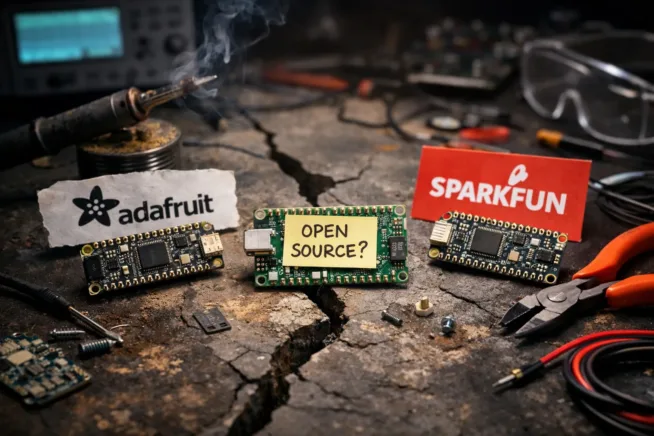
In recent days, the more observant part of the DIY and developer community may have noticed that something is happening around the popular Teensy development boards. Two well-known companies – Adafruit Industries and SparkFun Electronics – have ended their collaboration,…

AVR, ATMega, ATTiny, PIC, Arduino… these are very searching words in google and I asked myself “Why?”. Yes, AVR by Atmel or PIC by Microchip family is popular, but we can program better (modern, faster, more low-power, more peripherals) microcontrollers…

I would like to thank Richard Stefun for this very good article about ESP32 and development board. The IOT applications of new generation. After the launch of ESP-01 modules in 2014 that used the ESP8266 microcontrollers from Espressif Systems, the…

STMicroelectronics released the first microprocessor (don’t confuse with microcontroller). The new family of micoprocessor is called STM32MP1. The STM32MP1 combines ARM® Cortex®-A7 32-bit RISC @650 MHz and ARM® Cortex®-M4 @209 MHz. The key features are Arm® NEONâ„¢ and Arm® TrustZone®,…

Trends