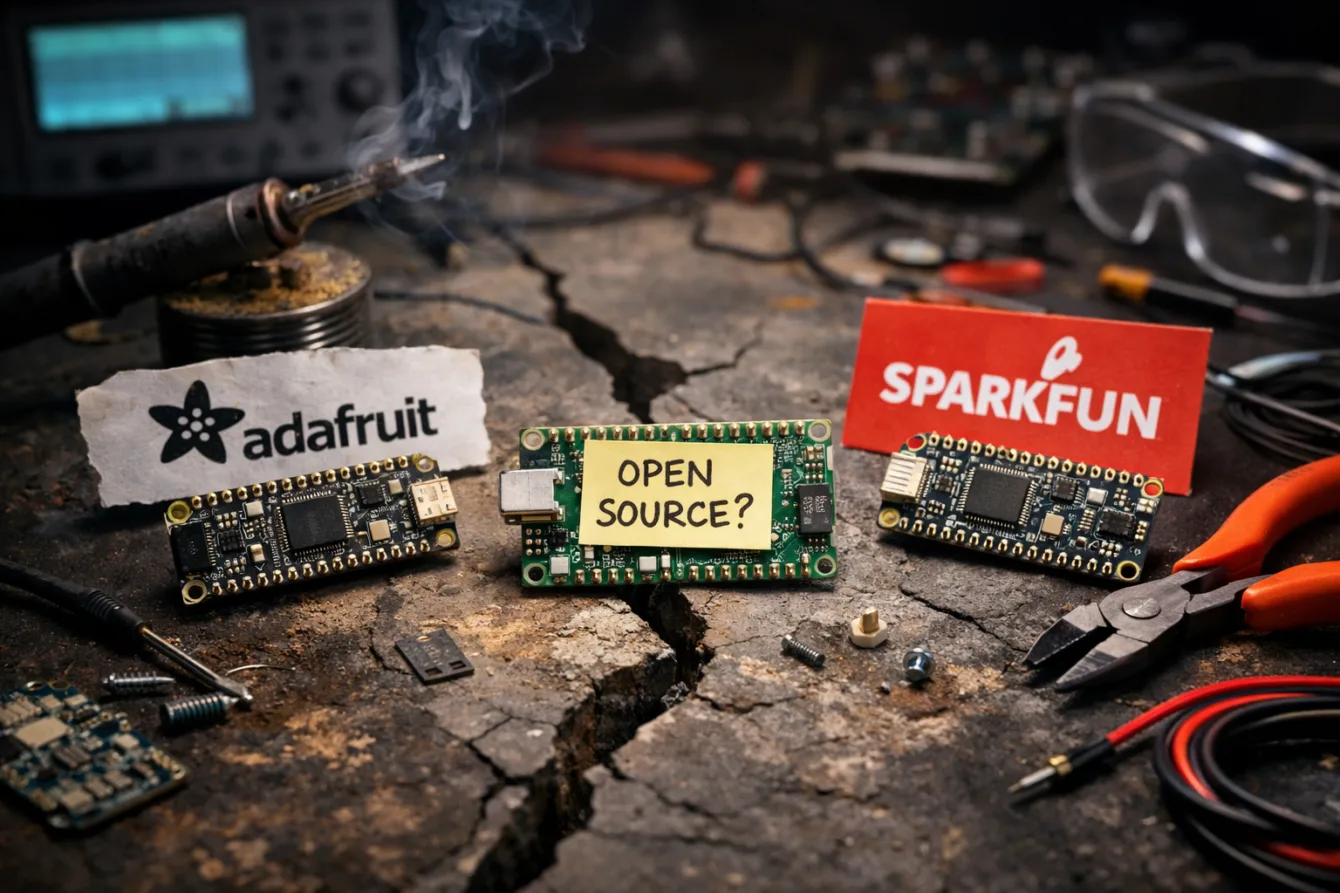
In recent days, the more observant part of the tinkerer and developer community may have noticed that something is happening around the popular Teensy development boards. Two well-known companies – Adafruit Industries and SparkFun Electronics – have ended their collaboration, which has sparked a fairly open public debate.
The debate on forums and social networks is very lively and engaging. I will attempt to outline the reasons for this end of friendship, what has subsequently happened, and what the impact on users – the tinkerers – might be.
What is actually going on
The Teensy development boards have long been very popular – especially due to their high performance, compact size, and strong software support. However, they are not fully open-source hardware: key parts of the ecosystem (such as the bootloader) remain closed.
Recently, the production and distribution of Teensy have become more centralized under SparkFun. This has led to Adafruit stopping the sale of Teensy and officially announcing their removal from the product lineup.
On its own, this would not be particularly remarkable – business relationships change regularly. However, what is interesting is that this time the situation is being openly discussed on community forums and in the media.
The Rumors
According to public statements, it did not start with a press release, but rather with a private email.
Adafruit representative, Phillip Torrone, reportedly contacted SparkFun’s management stating that:
- he was highlighting the behavior of some people from SparkFun
- he considered it inappropriate / crossing boundaries
- he warned SparkFun about the behavior of their people towards Limor Fried
The tone?
According to SparkFun’s reactions, it was “unacceptable, confrontational, and outside professional boundaries.”
According to Adafruit, it was “necessary and protective.”
SparkFun responded decisively – not with explanations, not with discussions, but with termination of collaboration.
In their official response, SparkFun claims that:
- such communication is not acceptable even among partners
- emails from Adafruit violated their Code of Conduct
- were personal, aggressive, and disproportionate
Different Perspectives
- Adafruit explains its decision not only with business reasons but also with a values misalignment. At the same time, it clearly states that it wants to offer users an alternative that will be more in the spirit of open hardware.
- SparkFun, on the other hand, emphasizes the need for professional boundaries and internal processes and has decided to go its own way without further collaboration.
It is important to say one thing:
This is not the end of the Teensy platform. Teensy (PJRC + SparkFun) will continue to exist and be sold – just not through the Adafruit channel.
Technical Side: Why Teensy is so Popular
To understand why there is so much attention around this, it is good to recall what Teensy offers (especially the 4.x series):
- powerful ARM Cortex-M7 up to 600 MHz
- up to 1 MB RAM
- very rich peripherals (SPI, I²C, UART, I2S, CAN, USB Host/Device)
- strong integration with the Arduino ecosystem (Teensyduino)
- very good performance for audio, DSP, and real-time applications
It is the combination of performance + ease of use that has made Teensy such a strong platform.
Open Adafruit Alternative: What is Coming
More interesting than the breakup itself is what comes next.
Adafruit and part of the community are openly discussing the development of an open-source alternative to Teensy. It is not yet a finished product, but rather a clearly articulated vision of what such a board should offer:
Expected Technical Features
- 32-bit MCU (ARM or RISC-V)
- performance comparable to Teensy 4.x
- at least hundreds of kB RAM, ideally 1 MB or more
- QSPI Flash / PSRAM
- USB Device + Host
- rich I/O (ADC, PWM, SPI, I²C, UART)
- open bootloader and documentation
Software Side
- Arduino / PlatformIO compatibility
- open tools
- debugging capability (SWD/JTAG)
- no proprietary “black boxes”
In other words: the performance of Teensy, but without ecosystem lock-in.
Sources:
https://news.ycombinator.com/item?id=46616488
https://blog.adafruit.com/2026/01/12/discontinuing-the-teensy-at-adafruit/
https://www.eevblog.com/forum/microcontrollers/open-source-teensy-compatible-what-features-do-you-want/
https://www.sparkfun.com/official-response https://www.theregister.com/2026/01/15/sparkfun_cuts_ties_with_adafruit/