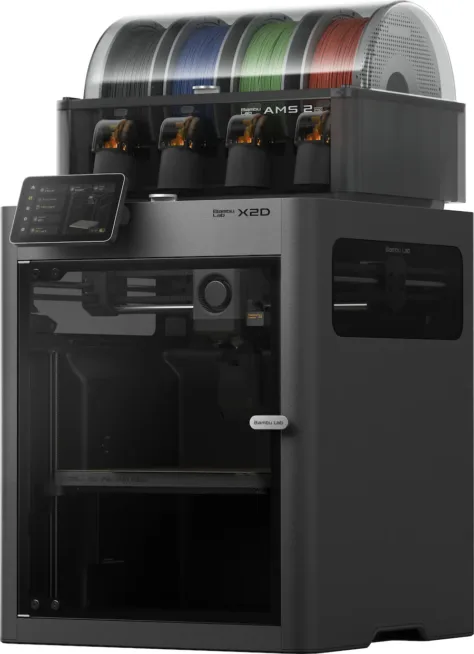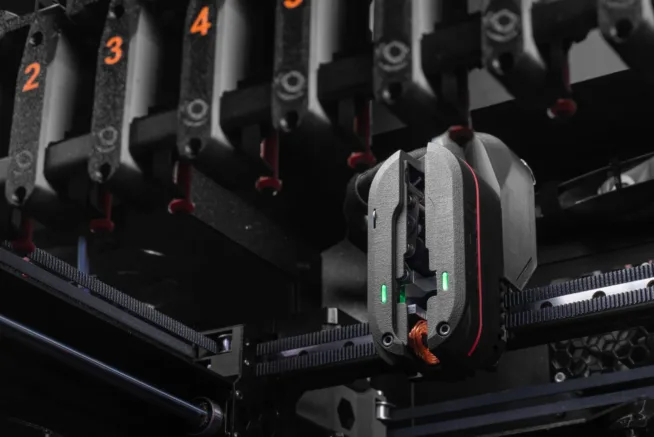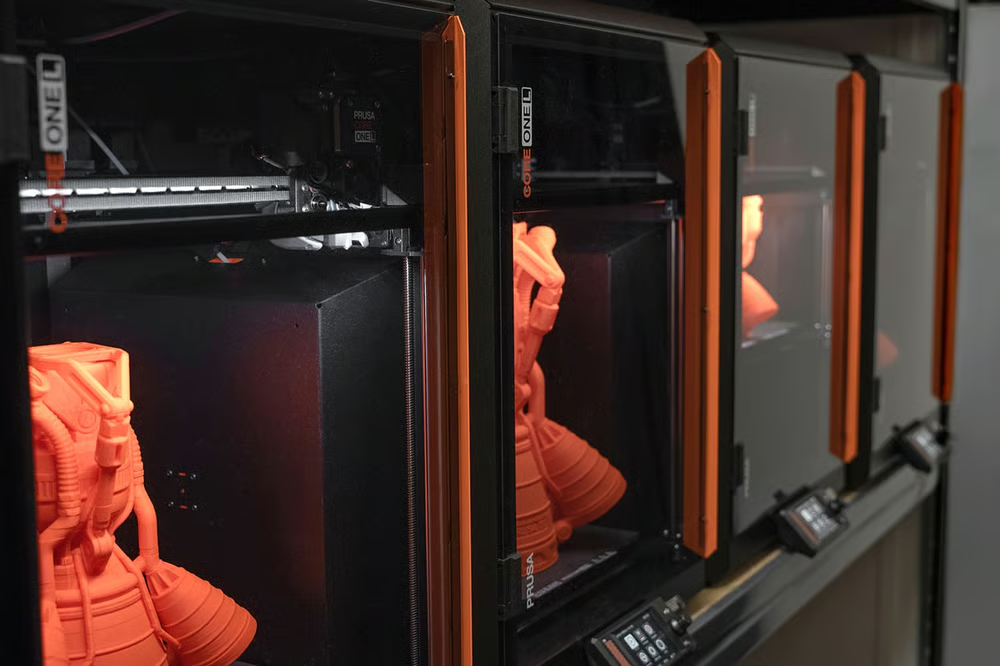
If you’re thinking about buying a 3D printer, you’ve probably run into Bambu Lab. Their machines are cheap, fast, and user-friendly. But there’s a backstory you should know before you pull out your wallet.
The Chinese company Bambu Lab built their printers on the open-source work of the community. Now they’re threatening to sue a Polish developer who used their own public code. The community is up in arms, big YouTubers are offering money for his legal defense. What does this mean for the average 3D printer buyer?
How Bambu Lab Got Started
The 3D printing world stands on open-source foundations. For over a decade, the developer and enthusiast community has built software, firmware, and hardware solutions that anyone can use freely. That’s how anyone could take existing work and build their own product on it.
That’s exactly what Bambu Lab did. They took PrusaSlicer (which itself roots back to Slic3r), turned it into their own version—Bambu Studio—and added their hardware. Developing a slicer from scratch would take years; this way, they did it in a fraction of the time. And that’s fine—the AGPL license allows it. It has one condition: if you modify open-source code and distribute it, your changes must stay open-source too.
Slicer: software that converts a 3D model into instructions for the printer
Where the License Problem Comes In
Bambu Lab did release the Bambu Studio code, but the network plugin—the part that talks to their cloud—is kept as a closed binary blob. It downloads at runtime, isn’t in the GitHub repo, and no one can inspect or audit it. Critics say this violates the AGPL license the whole slicer inherited. Josef Průša, founder of Prusa Research, calls it out publicly, saying Bambu Studio has violated PrusaSlicer’s AGPL license from the start of the fork.
For the layperson: Imagine buying a paper printer. After a year, the manufacturer updates it to block any software but theirs. And their software? Who knows what it does—sends copies of every document to servers in China? Snoops on your network? Or joins a DDoS attack? Hypothetically. Without seeing their code, no one can confirm or deny it. That’s the big issue, especially combined with the laws Chinese companies must follow—more on that below.
January 2025: Bambu Locks Down the Ecosystem
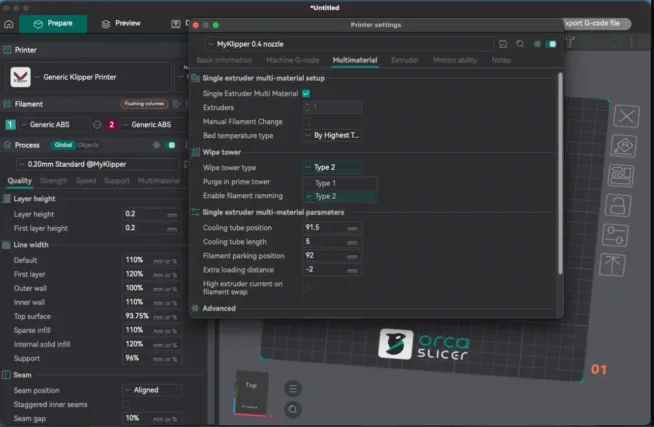
In January 2025, Bambu Lab released a firmware update that blocked third-party direct access to their printers via the cloud. The main victim was OrcaSlicer—a popular alternative slicer that’s basically the “grandchild” of PrusaSlicer (OrcaSlicer forks Bambu Studio, which forks PrusaSlicer, which comes from Slic3r). OrcaSlicer offered experimental features the official software lacked, and lots of users preferred it.
Bambu Lab said: Want to use OrcaSlicer? Route it through our Bambu Connect app, which acts as a middleman. But Bambu Connect severely limited what OrcaSlicer could do with the printer—it could see settings but not change them. Speed, temperature, AMS colors—all that had to be set manually right on the printer.
The community revolted. The company was locking down features that were available when you bought the printer.
May 2026: Developer Restores Access, Bambu Threatens Lawsuit

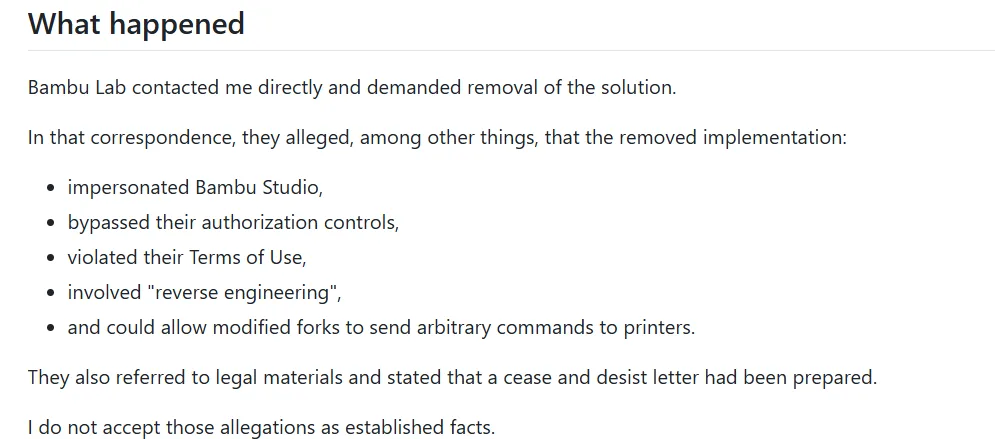
Polish developer Paweł Jarczak made a fork of OrcaSlicer that restored direct cloud access to Bambu printers. Key detail: he used code from Bambu Studio’s own public AGPL sources. He didn’t break any security or use proprietary code. He just took what Bambu Lab themselves released under open-source license.
Bambu Lab fired back with a legal threat—a cease and desist—accusing him of “impersonation” (posing as official software) and “reverse engineering.” Jarczak asked Bambu Lab to pinpoint exactly which code or commit was problematic and on what legal grounds. Instead of replying, Bambu Lab posted a blog accusing Jarczak publicly, without giving him a chance to respond on the same platform.
Under pressure, Jarczak took down the repo. One guy from the community against a billion-dollar Chinese firm.
The Community Says: Enough
The backlash came fast, from the biggest names in the tech community.
Louis Rossmann, the right-to-repair advocate with 2.5 million YouTube subscribers, made a video where he told Bambu Lab to go to hell and offered $10,000 for Jarczak’s legal defense. He uploaded the OrcaSlicer-BambuLab code to his own GitHub under the FULU (Freedom from Unethical Limitations) organization.

Gamers Nexus, one of the most respected tech channels on YouTube, went further. Steve Burke published an article with a title that doesn’t need translating, offered another $10,000 for the defense, and hosts Jarczak’s code on his GitHub. And crucially—GN announced they’re switching from Bambu printers to Prusa. They ordered $5,000 worth of Prusa gear and plan to phase out their Bambu machines.
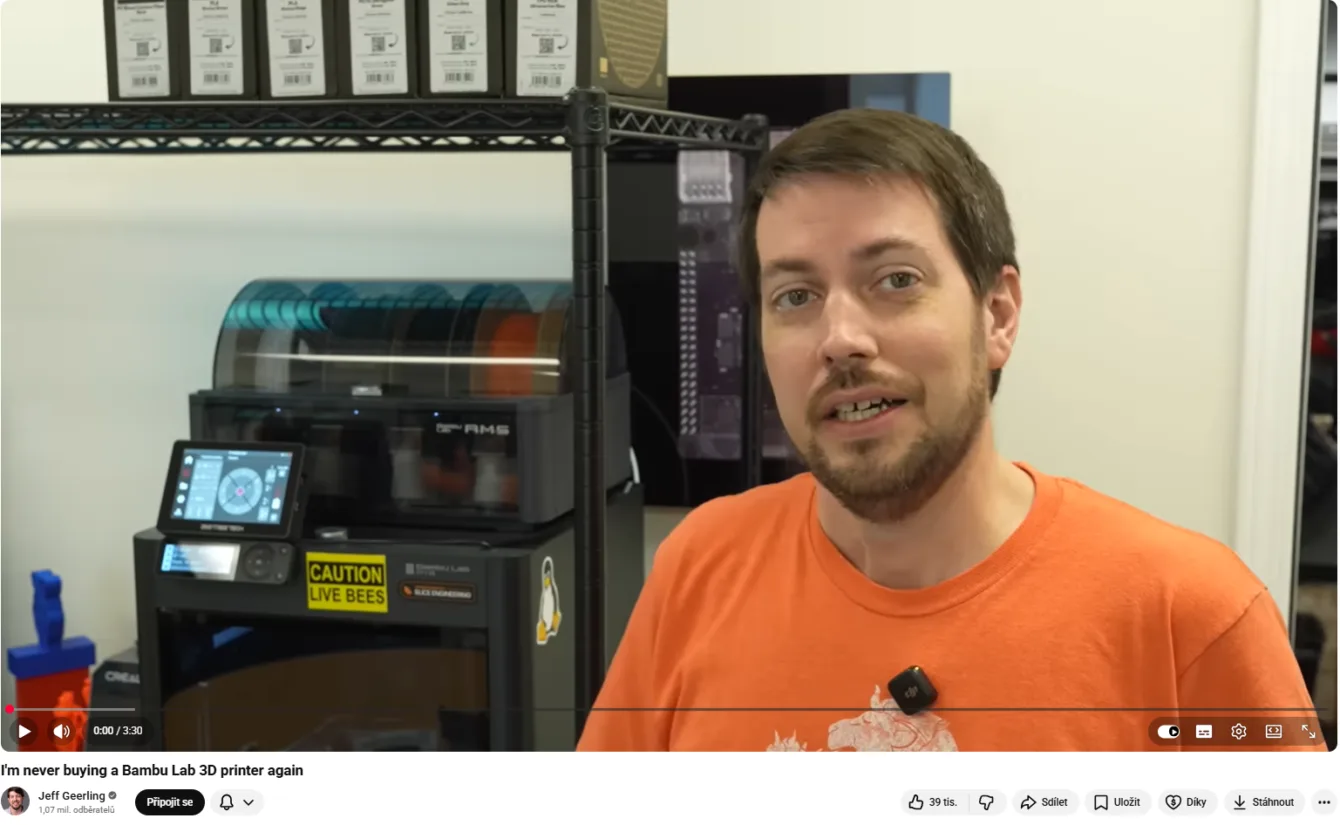
Jeff Geerling, open-source developer and hardware reviewer with a million subscribers, wrote a long piece on how Bambu Lab is abusing the open-source social contract. He made a video titled “I’ll Never Buy a 3D Printer from Bambu Lab Again” and disconnected his own Bambu Lab P1S from the internet, firewalled it, and switched to OrcaSlicer.
Snapmaker, a competitor, chipped in by donating a Snapmaker U1 printer with open-source Klipper firmware to Jarczak for further development.
Legal commentary came from Leonard French, a copyright lawyer and YouTuber, who called this a textbook case of “progressive enclosure”—the strategy where manufacturers gradually turn one-time hardware sales into ongoing subscription services via software locks.
Why This Should Matter to You, Even If You Don’t Print
This story isn’t just about 3D printing. It’s a prime example of a pattern repeating across the entire tech industry: a company takes the community’s open-source work, builds a commercial product on it, then tries to lock down the ecosystem to keep users dependent. When someone exercises the rights the open-source license gives them, they get a legal threat.
For the average user, it means: You buy a printer, and a year later, the manufacturer can cut off the software you’ve been using with a firmware update. And if someone tries to restore that functionality, the company sics lawyers on them.
Chinese Laws and Why They Matter
There’s another angle that doesn’t get much airtime. Bambu Lab is a Chinese company (based in Shenzhen) and subject to Chinese legislation. That includes several laws relevant to anyone connecting their printer to the internet:
National Intelligence Law (2017)—all organizations and citizens must cooperate with intelligence services. The law also forbids informing anyone about this cooperation.
Cryptography Law (2020)—commercial encryption must be state-approved. On request, companies must provide decryption keys.
Data Security Law (2021)—the state has extraterritorial reach over data touching Chinese national interests. Jurisdiction follows the company, not the server. Hosting data in the EU or US offers no protection.
Counter-Espionage Law Amendment (2023)—espionage definition expanded to documents, data, and materials related to national security and interests. Industrial data is explicitly in scope.
Vulnerability Reporting Regulations (2021)—any discovered software vulnerability must be reported within 48 hours. Data goes to CNNVD, run by the 13th Bureau of the Ministry of State Security.
What does this mean in practice? Bambu Lab routes your print jobs through their cloud. When you print a product prototype, that file passes through their servers. And Chinese law requires the company to cooperate with intelligence services if asked—and not tell anyone about it. The Czech NÚKIB warned about exactly this.
Market State: 95% Owned by China
Six years after China started heavily subsidizing 3D printing, Chinese companies hold about 95% of the global desktop 3D printer market. Prusa Research is the last Western manufacturer standing. Five years ago, nearly every European country and many US states had their own makers. They’re all gone now.
My Take on All This
When you’re shopping for a 3D printer, don’t just look at price and specs—consider how the company treats the community that helped it get off the ground. Bambu Lab makes great hardware—no one’s arguing that. But their approach to open-source, ecosystem lockdowns, and legal threats against individual developers show where they’re headed.
If one dominant company ends up controlling the whole 3D printing sector, it becomes a monopoly. And we all know how monopolies work… Total dependency. Sigh.
Josef Průša weighed in on the issue on X, highlighting the AGPL violation and linking it to five Chinese laws that should make anyone think twice about connecting a Chinese printer to the internet.