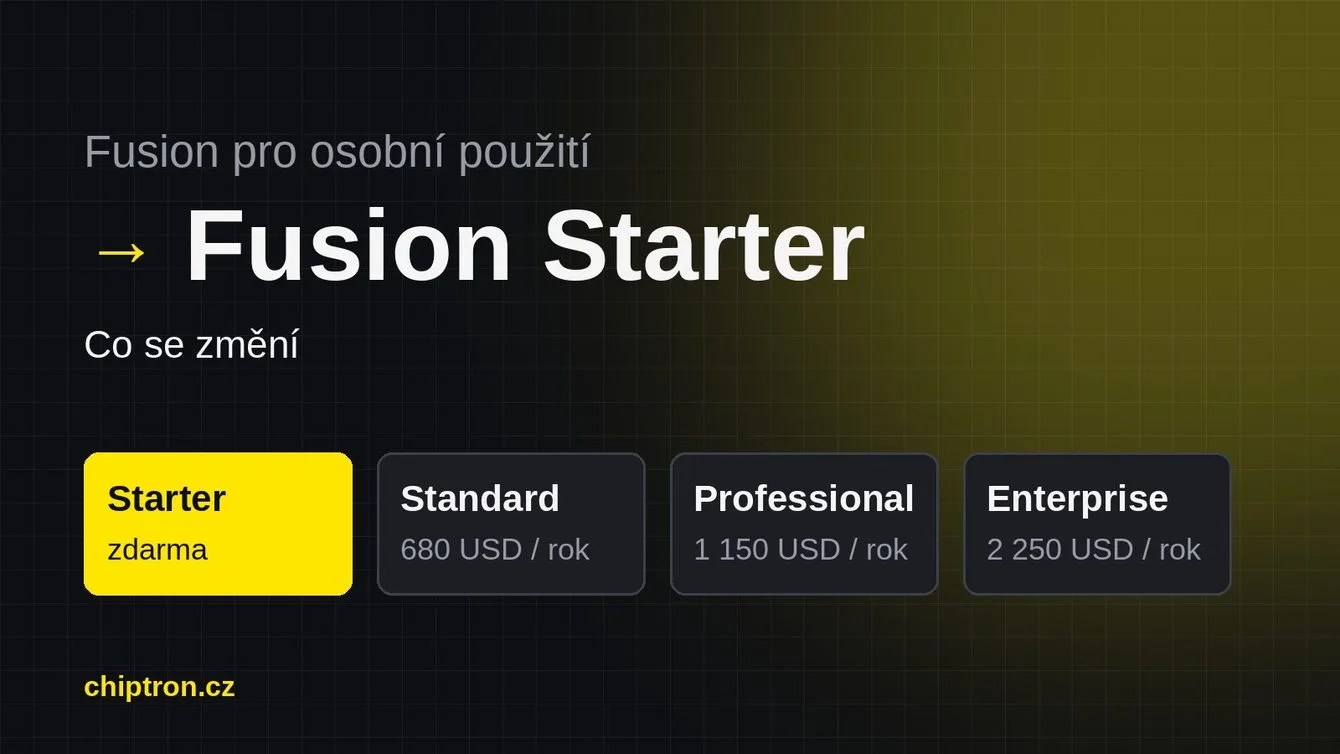
I got an email from Autodesk today with the subject line “New name, same workflows”. Starting January 28, 2027, Fusion for personal use will be renamed Fusion Starter.
If you use Fusion to design electronics enclosures or 3D-printed parts, you’ll probably want to pay attention. Autodesk has changed its free license several times before, and each time it came with some restriction. This time, things look different. At least for now.
What’s changing for hobby users
According to Autodesk, nothing but the name. Fusion Starter will remain free for personal, non-commercial use. Nothing needs to be migrated or reinstalled, and your projects will stay where they are. The transition happens automatically.
Starter is supposed to have the same features as the current personal-use license. That also means the same limitations. If you were hoping the new name would come with fewer restrictions, you’ll be disappointed.
Why Autodesk is doing this
Over the past few years, Fusion has grown into quite a tangle. There’s the basic Fusion plan, paid add-ons (Extensions), Fusion for Design, Fusion for Manufacturing, and other packages. It wasn’t exactly easy to work out what you were actually paying for.
Autodesk is now consolidating everything into four plans.
New plans and pricing
These are the recommended annual prices in US dollars.
- Starter: free, for non-commercial use only
- Standard: $680, with CAD, CAM, PCB, and manufacturing tools for individuals
- Professional: $1,150, adding advanced manufacturing, simulation, collaboration, and data management
- Enterprise: $2,250, with full manufacturing and simulation, PLM with AI agents (still marked “coming soon”), and the most AI tokens
Each higher-tier plan includes everything in the one below it. Standard costs the same as today’s paid Fusion plan. PCB design, the successor to Eagle that I wrote about in my article on Eagle and Fusion 360 Electronics, is already included in Standard.
What current subscribers will get
Subscriptions will be moved to the new plans automatically:
- Paid Fusion → Professional
- Fusion for Design or Fusion for Manufacturing → Enterprise
- Manufacturing or Simulation extension → Enterprise
- Design extension → Professional
- Fusion for personal use → Starter
Autodesk says nobody will lose features, and that some will get more. Exactly what you get depends on what you’re paying for now.
Offer available through January 27
Buy or renew a subscription by January 27, 2027, and your price is guaranteed for two years:
- Fusion with Professional features for $680 instead of $1,150 per year
- Fusion for Manufacturing with Enterprise features for $2,040 instead of $2,250
- Fusion for Design with Enterprise features for $2,190 instead of $2,250
For people using Fusion commercially, this is the most interesting part of the announcement. Professional features for the price of today’s Fusion plan means a saving of $470 a year.
IMPORTANT! The locked-in price only applies if your subscription stays active without interruption. If it expires, you’ll have to renew at the new price. The offer also excludes Fusion Early Adopter, Fusion Legacy, standalone extensions, and packages such as Fusion with Moldflow.
So, should you worry?
My take: this is good news. The free version isn’t going away, and hobby users don’t need to do anything. I’d just keep an eye on whether “same features” still means the same thing after the rename. Autodesk has cut back the hobby license before. In 2020, it limited users to 10 active editable documents and removed some export formats. STEP export only came back after a wave of criticism from the community.
If you want to depend on Autodesk as little as possible, KiCad or EasyEDA are options for PCB design, and FreeCAD for 3D CAD.
Links: Autodesk: new Fusion plans